
The Baby Boomer Card Inheritance Wave Is Here

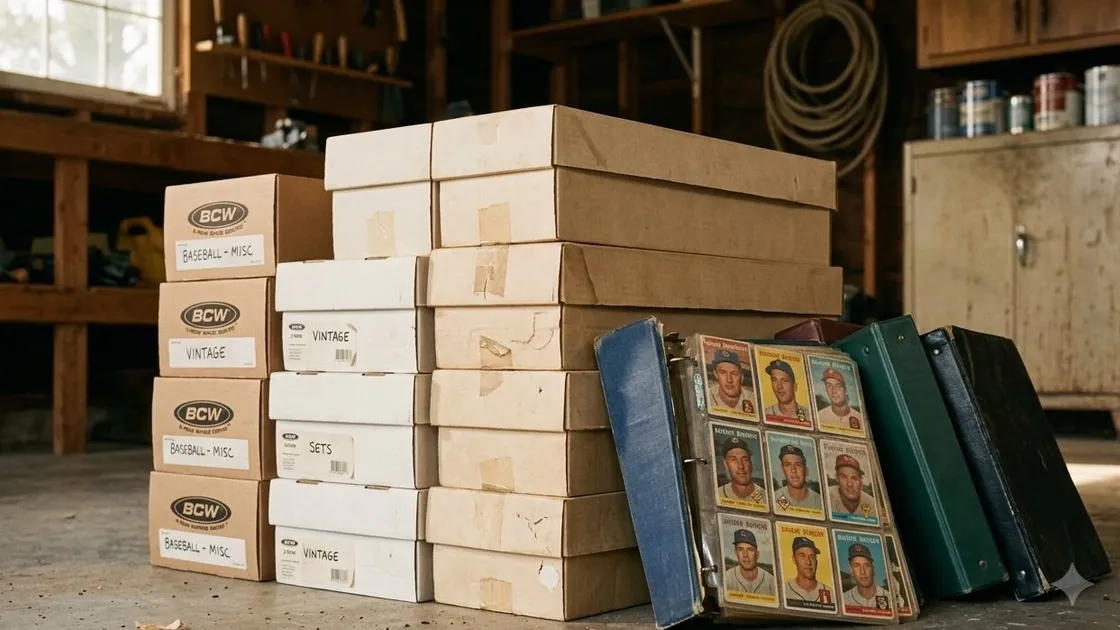
If it feels like everyone you know suddenly has a box of somebody else’s baseball cards to deal with, you’re not imagining it. There’s a real wave happening. Understanding it will make you better at deciding what to do with a collection you’ve inherited, starting with why patience is worth more right now than you’d guess.
The generation that made the hobby is passing it down
The Baby Boomers, born roughly 1946 to 1964, are the generation that turned baseball cards from a kids’ pastime into a serious collecting hobby. They were children during the golden age of the 1950s and 60s. They collected again as adults through the boom of the 80s and 90s. A lot of them built substantial collections across a lifetime of it.
That generation is now in its 60s, 70s, and 80s. They’re downsizing out of family homes, moving somewhere smaller, and passing away. Decades of accumulated cards are coming out of closets and attics and safe deposit boxes all at once, landing with children and grandchildren who mostly have no idea what any of it means.
That’s the wave. You’re in it, and so are a lot of other people this week.
What it means for what you inherited
The genuinely old cards are the story. A Boomer’s collection tends to span everything from what they had as kids in the 1950s and 60s, which can be very valuable, to what they bought as adults during the junk-wax era, which usually isn’t. Value concentrates in the oldest and best-preserved pieces. You can see the gap plainly in the real price ranges by era. Don’t let the sheer volume of low-value cards hide the few that matter, and here’s how to tell them apart.
More supply means more reason to be picky. With so many collections surfacing together, common cards are more common than ever and there’s a lot of noise. Scarce, high-grade vintage holds its value regardless. Ordinary cards face real competition. One more argument against dumping the whole thing in a bulk sale before you’ve found the good pieces.
And more collections means more predatory buyers. Where there’s a wave of inheritors who don’t know what they have, there’s a wave of buyers hoping to profit from exactly that. Estate operations and “we buy old cards” outfits know the demographics perfectly well. Plenty of them are honest. Some are counting on you not knowing there’s a $3,000 card in the box. Telling those apart is the whole game, and it’s why my name and my honesty promise are on everything here.
Why patience beats panic
The most common regret I hear from inheritors is selling too fast. Dumping the whole collection on the first buyer, or at an estate sale, or in a rushed lot, before anybody looked carefully.
Cards aren’t perishable. They’ve survived 50 or 70 years already. They’ll survive a few more weeks while you work out what you have.
Cards aren't perishable. They've survived 50 or 70 years already; they'll survive a few more weeks while you figure out what you have.
So if you’ve just inherited a collection, the wave isn’t a reason to hurry for the exit. It’s a reason to slow down, find the pieces that matter, and sell each one the way that suits it. For the genuinely great cards, that’s rarely the fastest way.
If you want a hand sorting the signal from the noise
I look at these collections constantly, and the pattern barely changes: a great many ordinary cards, and a few worth real money that are easy to walk straight past.
Send me photos and a rough description of what you inherited and I’ll give you an honest read. What era it’s from, what’s actually valuable, and the smartest way to handle it. No cost, no pressure, no clock running.
Key takeaways
- Baby Boomers built the modern hobby; now those collections are changing hands en masse.
- The value is concentrated in the oldest, best cards — often 1950s–60s, not the junk-wax layer.
- More supply means common cards face more competition, so be selective before a bulk sale.
- More inherited collections also means more predatory buyers — know what you have first.
- Patience beats panic: cards aren't perishable, and rushing is the most common regret.
Frequently asked questions
- Are more baseball card collections being inherited right now?
- Yes. The Baby Boomer generation that built large collections is downsizing and passing away, so a wave of long-held collections is reaching heirs and the market at the same time.
- Are inherited baseball cards worth more because they're old?
- Not automatically. A Boomer's collection often spans valuable 1950s–60s cards and near-worthless late-80s/early-90s ones. Value tracks scarcity and condition, not age alone.
- Should I sell an inherited collection quickly?
- Usually not. The most common regret is selling too fast to the first buyer before anyone identified the good pieces. Cards aren't perishable — take the time to find out what you have.
- Why are so many card collections for sale right now?
- Demographics. The generation that drove the hobby's growth is at the downsizing-and-estate stage of life, so decades of accumulated collections are surfacing together.