
Baseball Cards in an Estate: A Guide for Executors

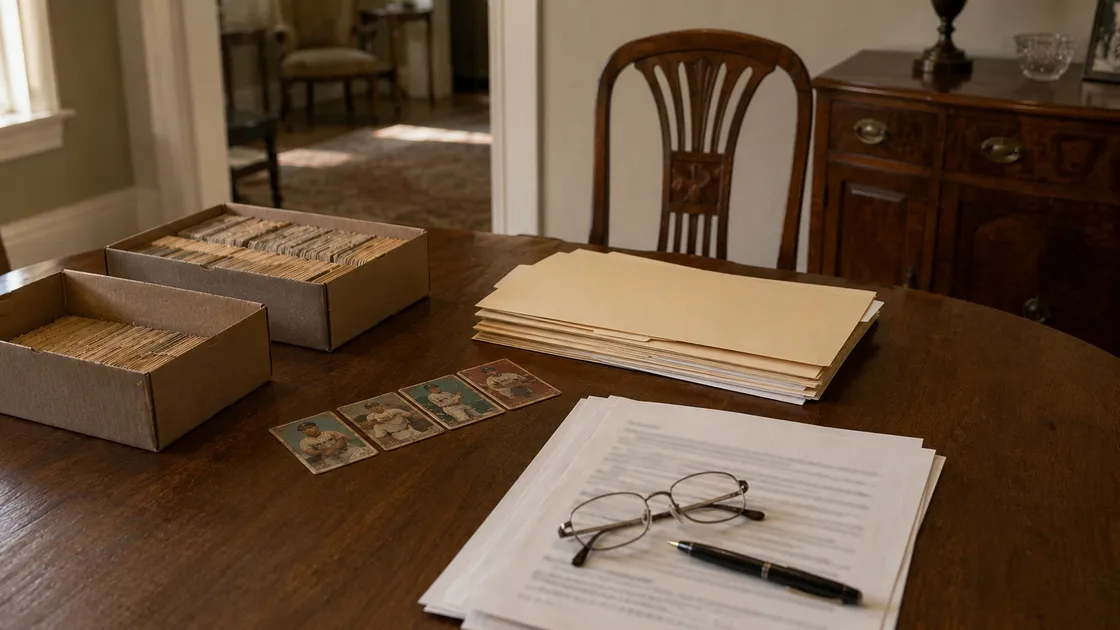
This is practical guidance, not legal advice. Anything touching the estate’s tax position, court filings, or your duties as personal representative is a question for the estate’s attorney.
If you’re settling an estate and a card collection has turned up, you’ve been handed an awkward asset. Not because it’s necessarily valuable. Often it isn’t. It’s awkward because you can’t tell by looking, and neither can most of the people who’ll offer to take it off your hands.
Why cards are difficult in a way that furniture isn’t
Most estate property scales with what you can see. A bigger, nicer thing is worth more. Card collections don’t behave that way, for two reasons.
The first is that value concentrates. In a typical collection a handful of cards carry most of the worth and the remaining several thousand are close to worthless. Twelve boxes might hold $300 of ordinary cards and one card worth $4,000. Nothing about the boxes tells you which of those you’re looking at.
The second is that the valuable card is rarely the impressive-looking one. Condition drives an enormous share of value on older cards — the same card can be worth $80 or $8,000 depending on centering and corners — and nobody makes that judgment from across a room.
So volume tells you nothing here, and neither does a quick glance.
The two ways this goes wrong
It gets disposed of unexamined. The collection goes out with the estate-sale miscellany, or to whoever offered a few hundred dollars for the lot, and a valuable card leaves with it. This happens constantly. It’s usually nobody’s deliberate fault and it can’t be undone.
Or everyone assumes it’s a fortune. Someone remembers hearing about a Mickey Mantle card that sold for millions, and the estate holds out for a number this collection was never going to reach. Months of delay, sometimes a family argument, over an asset that was worth $600 all along.
Same root cause both times: nobody established what was actually in there.
What to do first
- Leave it as it is. Don’t clean anything; cleaning or “fixing” a card reliably lowers its value. Don’t sort aggressively. Don’t throw out boxes, wrappers, albums, or packaging, all of which can carry value themselves.
- Photograph it where it sits, before anything moves. Wide shots of how it was stored, then closer shots of any cards that are individually sleeved or framed. That’s usually where the owner kept the ones they cared about.
- Secure it. A collection sitting in an open garage during a house clearance has a way of shrinking.
- Get eyes on it before anything is distributed or sold.
What a valuation should actually give you
Not a single number for the box. It should tell you:
- Which eras and sets are in there
- Which specific cards carry the value, and what condition they’re in
- What those cards have recently sold for, with the comparable sales cited
- What the remainder is realistically worth in bulk
- The sensible route for each part, because the answer for one great card is often auction while the answer for the other nine thousand is a single lot sale
Keep it in the file with the date and the name of whoever produced it. If a beneficiary asks two years later why the collection was sold for what it was, that document is the answer.
The record that answers "why did we sell it for that?" is usually worth more than the difference being argued over.
Valuation and appraisal are not the same word
They get used interchangeably. They shouldn’t be.
A valuation from a specialist is a knowledgeable read of what’s there and what it’s worth. It’s what you need in order to decide anything, and it’s normally free.
A formal appraisal is a credentialed product: a certified appraiser working to professional standards, producing a document meant for tax filings or the court. Whether the estate needs one depends on its size and your jurisdiction, which is a question for the attorney rather than for me.
Anyone offering to “appraise” your collection free of charge is offering the first thing while borrowing the word for the second. Often that’s still useful. Just know which one you’re getting.
A rough orientation on what’s likely in there
Pre-1980, and especially the 1950s and ’60s, is where value tends to live. Those boxes deserve real examination.
Roughly 1987 to 1994 is the junk-wax era. Printed in the billions, and worth very little even in perfect condition. It’s frequently the visible top layer, which is exactly why collections get written off too fast.
Unopened packs and boxes, complete sets in binders, and anything oddly sized or foreign-looking should be flagged rather than guessed at. Scarce regional and international issues can be worth many times a mainstream card of the same player.
One heuristic worth carrying: the junk-wax layer on top tells you nothing about what’s underneath it. Collectors routinely kept their best cards somewhere else entirely — at the bottom, in a closet, occasionally in a safe deposit box nobody has opened yet.
If you handle estates professionally
Liquidators, probate attorneys, auction houses: the same problem turns up over and over. Cards sit outside your specialty, and guessing at them exposes you in both directions.
I work with estate professionals across Central Florida. Free honest reads on collections you come across, referral fees when something turns into a deal, and documentation that the family and the file can both stand behind. Details are here.
For executors
Send photos and I’ll tell you what’s there, what carries the value, and what I’d pay if the estate wants to sell. That includes telling you when a card would do better at auction than in any private sale. It costs nothing and obligates the estate to nothing.
If you’d rather get your bearings first, here’s how to spot the signals of a valuable collection, and here’s what these cards tend to sell for.
Key takeaways
- Value is concentrated: a few cards commonly carry most of the worth, and they aren't the obvious ones.
- Don't distribute or dispose of any of it before someone who knows old cards has looked.
- Cards from roughly 1987–1994 are nearly worthless in bulk; pre-1980 is where value tends to sit.
- Document what was there, how the number was reached, and who valued it — that record protects the personal representative.
- A valuation is not a formal appraisal; if the estate needs one for tax or court, engage a certified appraiser.
Frequently asked questions
- How do you value a baseball card collection in an estate?
- Someone who knows vintage cards examines it and identifies the specific cards carrying the value, then prices those against recent comparable sales. A blanket per-card or per-box figure is not a valuation, because the value in almost every collection sits in a small number of cards.
- Does a baseball card collection need a formal appraisal for probate?
- Sometimes — it depends on the estate's value, the jurisdiction, and whether the figure will be used for tax or filed with the court. That's a question for the estate's attorney. A specialist's written valuation is useful for deciding what to do; it is not the same as a USPAP-compliant appraisal from a certified appraiser.
- What should an executor do first with inherited baseball cards?
- Leave them as they are. Don't clean, sort aggressively, or discard boxes, wrappers, and albums, which can carry value themselves. Photograph the collection as found, then get someone who knows vintage cards to look before anything is distributed or sold.
- Can beneficiaries just split up a card collection?
- They can, but dividing it before it's been valued is where disputes start — one beneficiary may unknowingly take the item holding most of the value. Establish what's there and what it's worth first, then divide against known numbers.