
Are 1987 Topps Worth Anything? The Honest Answer

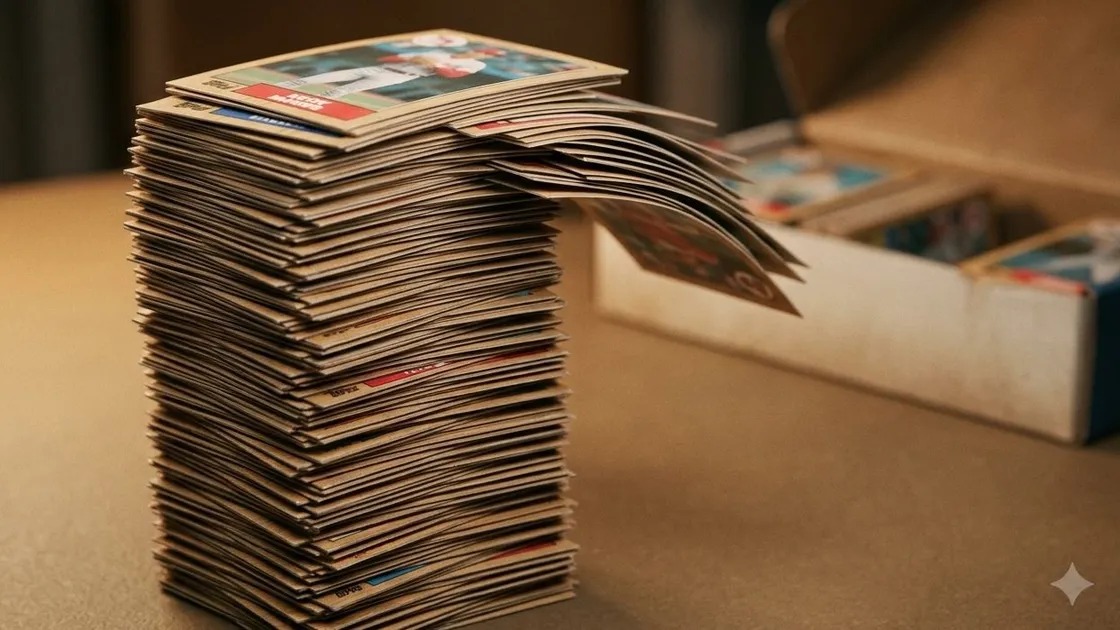
You’ve got a stack of 1987 Topps. Maybe a big one. That wood-grain border, the look everybody remembers. They’re old, they’re in nice shape, there are hundreds of them. They must be worth something.
Here’s the honest answer, because being the person who tells you the truth about this is the entire point. For the vast majority of 1987 Topps, no. They aren’t worth much. Often a few cents each, even in great condition. Better you hear it from me now than find out after somebody has strung you along.
Why that is, and then the part that actually matters, which is the exceptions.
Why so many cards from this era are worth so little
The late 1980s and early 90s are known in the hobby as the “junk wax” era. Cards from the 50s and 60s had started fetching serious money, everyone noticed that baseball cards could be valuable, and the manufacturers responded by printing staggering quantities. Collectors bought them by the case and saved them in perfect condition, precisely because they expected them to be worth something one day.
The result was the opposite of scarcity. Sets like:
- 1987 Topps
- 1988 Donruss and Topps
- 1989 Donruss, Fleer, and Topps
- 1990 Topps and Fleer
- 1991 Fleer and Donruss
exist in such enormous numbers, in such good shape, that supply buries demand many times over. A card has to be scarce and wanted. These are wanted. They are the furthest thing from scarce.
Perfect condition doesn’t rescue them, either, because almost everybody else’s copy is perfect too. That’s the flip side of the condition-is-everything rule. Condition commands a premium only when the card was scarce to begin with.
Which is why “old and mint” isn’t the same as “valuable”
This is the hardest thing for people to accept, especially when they’ve inherited a big, carefully-kept collection from those years. The cards were saved because someone believed they would be worth money. The saving is the reason they aren’t. It feels backwards. It’s still true.
If most of your collection sits between 1987 and 1993, temper your expectations. Not to zero. But the value almost certainly isn’t in the thousands of commons. My real price ranges by era show where it does land.
The cards were saved because someone believed they'd be worth money. The saving is exactly why they aren't.
The exceptions, which is where the money hides
This part is worth reading twice.
Star rookie cards from the era. A few rookies from these years are valuable, especially in high grade. The big-name Hall of Famers who debuted then. One graded rookie can be worth more than the other thousand cards combined.
High-grade examples of key cards. For the small set of cards from this era that people do chase, a perfect graded 10 can be worth real money while a raw copy is worth a dollar. Grading separates the truly flawless from the merely nice, and in an era where everything is nice, that separation is the whole game.
Error and variation cards. This era produced a handful of famous printing errors that collectors prize. Most “errors” people spot are worth nothing. A few specific ones aren’t.
Anything older mixed in. Collections span decades. Your 1987s might be sitting on top of a stack of 1960s cards that are the real story. Never judge a box by its top layer.
| Usually worth cents | Worth a closer look |
|---|---|
| Base commons, 1987–1994 | Star rookie cards of the era |
| “Mint” cards everyone else also saved | Perfect graded-10 key cards |
| Complete factory sets from the era | Genuine error / variation cards |
| The junk-wax layer on top | Older cards hiding underneath |
So the right move isn’t “this is junk, toss it.” The era is mostly low-value, the exceptions are real, and they’re easy to walk straight past. That’s what a proper valuation is for, and why knowing what you have before you sell matters as much as it does.
The bottom line
If someone offers you a big number for a box of straight 1987 commons, be skeptical. Not because it’s too low, but because it might be a hook.
And if someone tells you your whole junk-wax collection is worthless and offers to take it off your hands, be just as skeptical. They may be scooping up the rookie you didn’t know was in there.
Send me photos of what you’ve got. I’ll tell you which era your cards are from, whether there’s anything in there that breaks the pattern, and what it’s really worth. Sometimes the honest answer is “keep these for the memories, they aren’t worth selling.” You’ll get that one too.
Key takeaways
- The late-80s/early-90s 'junk wax' era was massively overproduced — supply dwarfs demand.
- Perfect condition doesn't rescue them, because nearly everyone's copy is also mint.
- The real exceptions: star rookies, high-grade key cards, and true error/variation cards.
- Don't judge a whole collection by the junk-wax layer on top — older cards may be underneath.
- Be skeptical of both a big offer for straight commons and a 'it's all worthless' brush-off.
Frequently asked questions
- Are 1987 Topps cards worth anything?
- Most are worth only cents, even in great shape, because they were printed in enormous quantities. The exceptions are star rookie cards, high-grade examples of key cards, and genuine error cards.
- Why are 1980s and early-90s baseball cards worth so little?
- They're the 'junk wax' era — manufacturers printed cards by the billion and collectors saved them in mint condition expecting value. That overproduction is exactly why most aren't scarce, and scarcity is what drives price.
- Which junk-wax-era cards are actually valuable?
- A handful of star rookie cards, certain cards in a perfect graded 10, and specific documented error/variation cards. One graded rookie can be worth more than the rest of the box combined.
- Should I throw away my 1980s baseball cards?
- No — not before someone checks for the exceptions. The valuable rookie or error card is easy to miss, and older, genuinely valuable cards are often mixed in with the junk wax.