
How to Tell if a Baseball Card Collection Is Actually Valuable

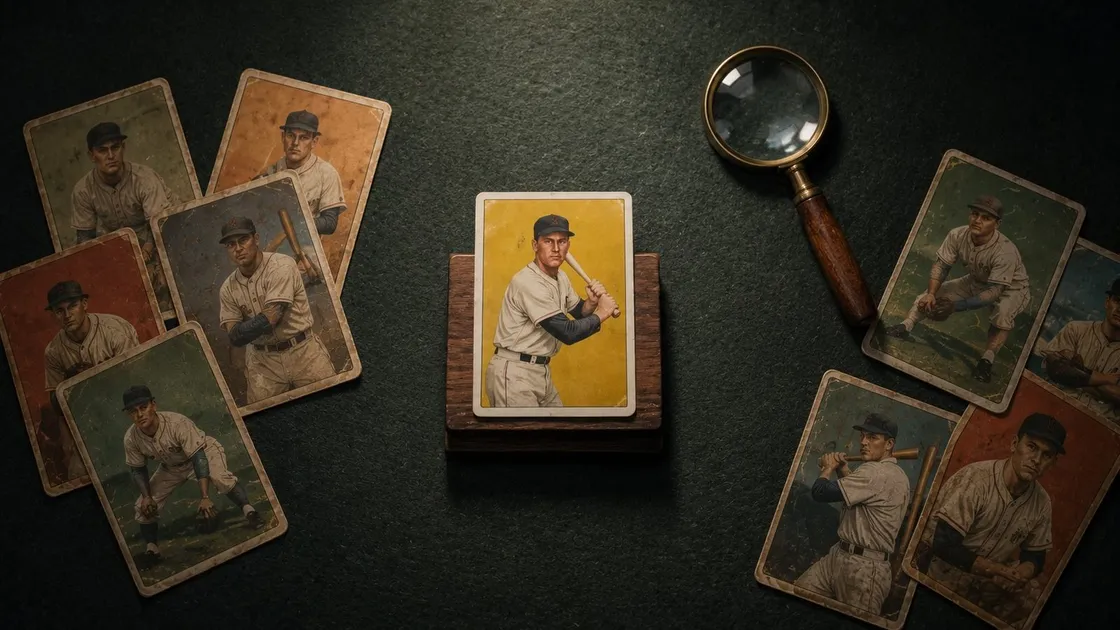
Whether the collection is yours or one you inherited, the question is the same, and everything else depends on it. Is this actually worth something?
The honest answer: most collections hold a great many near-worthless cards and a few that carry almost all the value. The whole game is telling them apart before you sell anything. Here are the signals that matter, roughly in order of how much they move the needle.
| Signal | What to look for | Why it matters |
|---|---|---|
| Age | Pre-1980, especially 1950s–60s | Fewer made, fewer survived, demand is deep |
| Player | Star names and rookie cards | One Mantle can outweigh the whole box |
| Condition | Sharp corners, even centering, clean surface | Can swing value 10× or more |
| Scarcity | Oddball, regional, error, short-print | Rarity can beat a famous common |
1. Age, but not the way you think
Older is generally better. The line isn’t gradual, though. It’s a cliff, and the cliff sits around 1980.
Pre-1980, especially the 1950s and 60s. Where real value concentrates. Fewer cards made, fewer survived, and demand runs deep. A 1952, 1953, or 1954 card of almost any Hall of Famer is worth serious money even in rough shape.
1980 to about 1986. A transition period. Some real value, a lot of common.
1987 to roughly 1994. The junk wax era. Printed in such enormous quantities that even mint copies are usually worth cents. If most of the collection sits here, brace yourself. Full explanation here.
So step one is finding the dates. The year is usually printed on the back, sometimes the front. A collection that’s mostly pre-1970 is a completely different conversation from one that’s mostly 1990.
2. Who’s on the card
Within any era the player matters enormously. A common player from 1961 might bring a dollar. A Mickey Mantle from that same set brings hundreds or thousands.
Names that reliably carry value: Mantle, Mays, Aaron, Clemente, Koufax, Jackie Robinson, Ted Williams. For later years, rookies of players who became legends. Rookie cards, a player’s first year, are especially prized.
You don’t need to memorize a list. You need to notice whether the big names of the era are in there, because a collection with two Mantles is worth investigating whatever else it holds.
3. Condition, and this is where people go wrong
For valuable cards condition isn’t a detail. It’s most of the value. The same 1955 card can be worth $80 or $8,000 depending on corners, centering, surface, and edges.
This is the most misunderstood part of the hobby, and it’s why untrained sellers get the price wrong in both directions. I wrote a whole piece on how condition, centering, and eye appeal decide value.
The takeaway for now: don’t judge a card by whether it “looks nice to you.” And whatever else you do, don’t try to improve the condition. You can’t. You’ll only lower it.
4. Scarcity and the oddball stuff
Some of the most valuable cards aren’t the famous ones. They’re the obscure ones. Regional issues, food-brand promotions, error cards, short-printed variations, international sets like Venezuelan Topps. These can be worth far more than a mainstream card of the same player, precisely because so few exist.
This is the corner of the hobby where inheritors most often leave money behind, because the valuable card looks less impressive than the shiny common beside it.
The valuable card often looks less impressive than the shiny common sitting right next to it.
The two mistakes to avoid
Overvaluing. Assuming the whole box is a jackpot because one card, or just the general aura of “old cards,” feels valuable. Usually the value sits in a few pieces and the rest is sentimental.
Undervaluing. Writing it all off as old cardboard and dumping it in a bulk sale. This is how a great card gets sold for a quarter.
Both come from the same place: not knowing what you have. And the frustrating part is that the fastest way to find out, showing it to a buyer, is also the way most likely to get you a self-interested answer.
How to actually find out
A few honest routes.
See real sold ranges by era. Before pricing any single card, here’s what vintage actually sells for, decade by decade, built from hundreds of real sales.
Look up specific cards yourself. Search completed and sold listings on eBay, not asking prices, for the exact card, year, and condition. Sold prices are reality. Asking prices are fantasy.
Check for graded cards. Anything already slabbed with a grade has a paper trail you can look up.
Get a free valuation from someone who’ll tell you the truth. The right buyer points out the good pieces and tells you honestly what’s common, because being right is the whole reputation, and the buyer who lies loses the next collection and the referral with it.
If you’re staring at a collection and can’t tell the treasures from the filler, that’s normal. It’s exactly what a valuation is for. Send some photos and I’ll tell you what’s there before you sell a thing.
Key takeaways
- Age matters most, and it's a cliff around 1980 — pre-1980 is where value tends to live.
- Within an era, the player is huge: stars and rookie cards carry the value.
- For valuable cards, condition is most of the value — and easy to misjudge.
- Scarce oddball and regional cards can outvalue a mainstream card of the same player.
- Avoid both over- and under-valuing; the cure is knowing what you have before you sell.
Frequently asked questions
- How can I tell if my baseball cards are valuable?
- Look at four things: age (pre-1980 is best), who's on the card (stars and rookies), condition, and scarcity. Then check recent sold prices for the specific card and condition, or get an honest valuation.
- Are old baseball cards always worth money?
- No. Age helps, but cards from roughly 1987–1994 were printed in such huge numbers that even mint ones are usually worth cents. 'Old' matters far less than 'old, wanted, and scarce.'
- What baseball cards are worth the most?
- Generally pre-1970 cards of Hall-of-Famers in high condition, key rookie cards, and scarce oddball or regional issues. A single such card can outweigh the rest of a collection.
- How do I find out what a specific card is worth?
- Search completed/sold listings (not asking prices) for the exact card, year, and condition — sold prices are reality. For anything you can't pin down, an honest valuation will place it.