
Fake and Altered Cards: The Worst Part of This Job

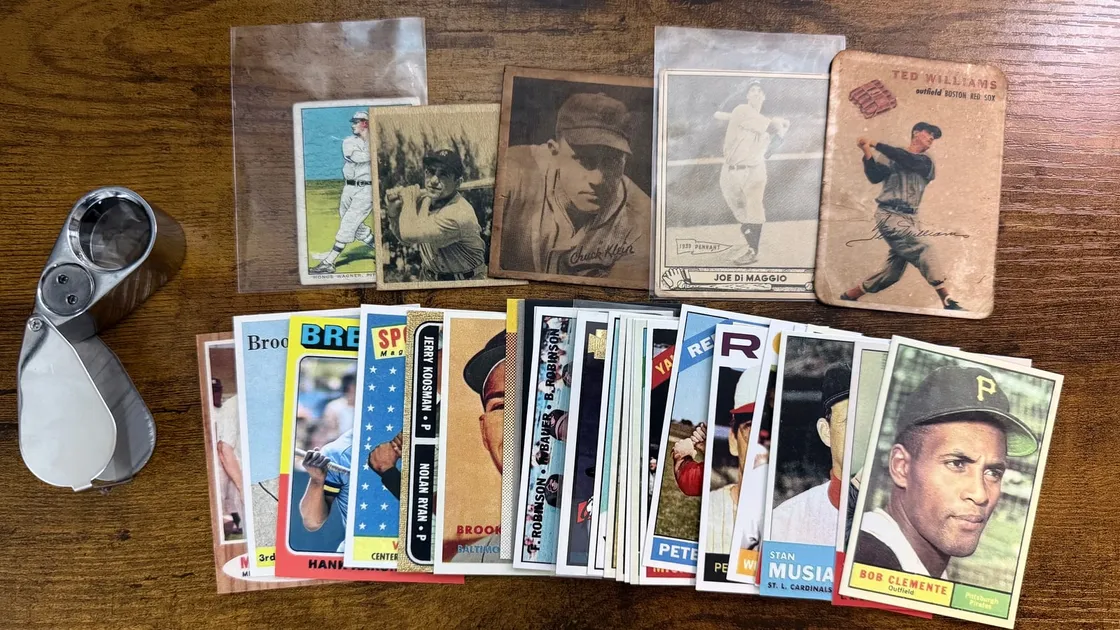
The worst part of this job is a kitchen table, a family being kind to me, and one card sitting between us that they’ve been counting on.
It’s usually the card the story is about. Grandpa’s Mantle. The Ruth that’s been in the family since forever. The one they mentioned in the very first email, because it’s the reason they got in touch at all. And then I have to say the thing that ends the story.
I don’t mean lowballing. I mean cards that aren’t what anybody in the room believes they are, including the person who’s owned it for forty years. It comes in three kinds, and they get more expensive as you go down.
| The news | What it means | How often |
|---|---|---|
| It’s real, but it’s common | The card exists by the million. The belief came from somewhere else. | Constantly |
| It isn’t real | A reprint or a counterfeit, bought in good faith decades ago. | A few times a year |
| It’s real, and someone trimmed it | Genuine card, altered to grade higher. Worth a fraction once caught. | Rarest, and the costliest |
The “error” that isn’t an error
This is the easy version. Somebody spots an ink smudge, a missing letter, or a crooked cut on a 1987 Topps or a 1990 Donruss, and it becomes The Error Card. It gets its own top-loader. It gets mentioned first.
A handful of genuine documented variations do exist and do carry a premium. But presses in that era ran for months, and whatever happened to your card happened to tens of thousands of others on the same run. The belief almost always traces back to a price guide, an old Beckett, or a forum post, and nobody has checked it since. Meanwhile the print runs from those years were enormous enough that plenty of it is worth very little regardless of what’s printed crooked.
Disappointing, but nobody paid fifteen thousand dollars for it. The other two are worse.
The stack I keep in a drawer
I have a small stack of counterfeits I’ve pulled out of collections over the years. Every one of them is a Hall of Famer. I keep them so I’ve got something to hold a real one up against.
Nobody I took those cards from was a crook. Somebody’s dad bought one of them at a show in 1985, paid real money for it, brought it home proud of himself, and slid it into a sleeve. Forty years later I’m the one standing in a kitchen telling his kids.
What usually gives them away: the card stock is wrong, too white or too thin or too glossy for its age. The printing looks soft, because it’s a copy of a copy. The colors are off in a way that’s obvious the moment a genuine one is lying beside it. And there’s no honest aging, because real ninety-year-old cardboard has lived somewhere.
None of that is a checklist you can run. Every one of those tells depends on having handled the real thing, and a good fake beats all of them.
The hardest one: a real card that’s been trimmed
A 1954 Topps Hank Aaron rookie went up on Facebook Marketplace this week. Fifteen thousand dollars, raw, out of state, with good clear photos. It’s a genuine card. It also appears trimmed to me.
I want to be careful with that wording, the same way I was careful when I posted a warning to my followers instead of an accusation. The seller may well have bought it exactly as it sits. That’s how these cards keep moving.
What bothered me first wasn’t any particular edge. It was that the card looked too good. A raw ’54 Aaron with corners that sharp is a rare thing, sharper than seventy years of being a piece of cardboard usually allows. On vintage, unusually clean for its age is a reason to look harder, not a reason to relax. Then I looked at the edges.
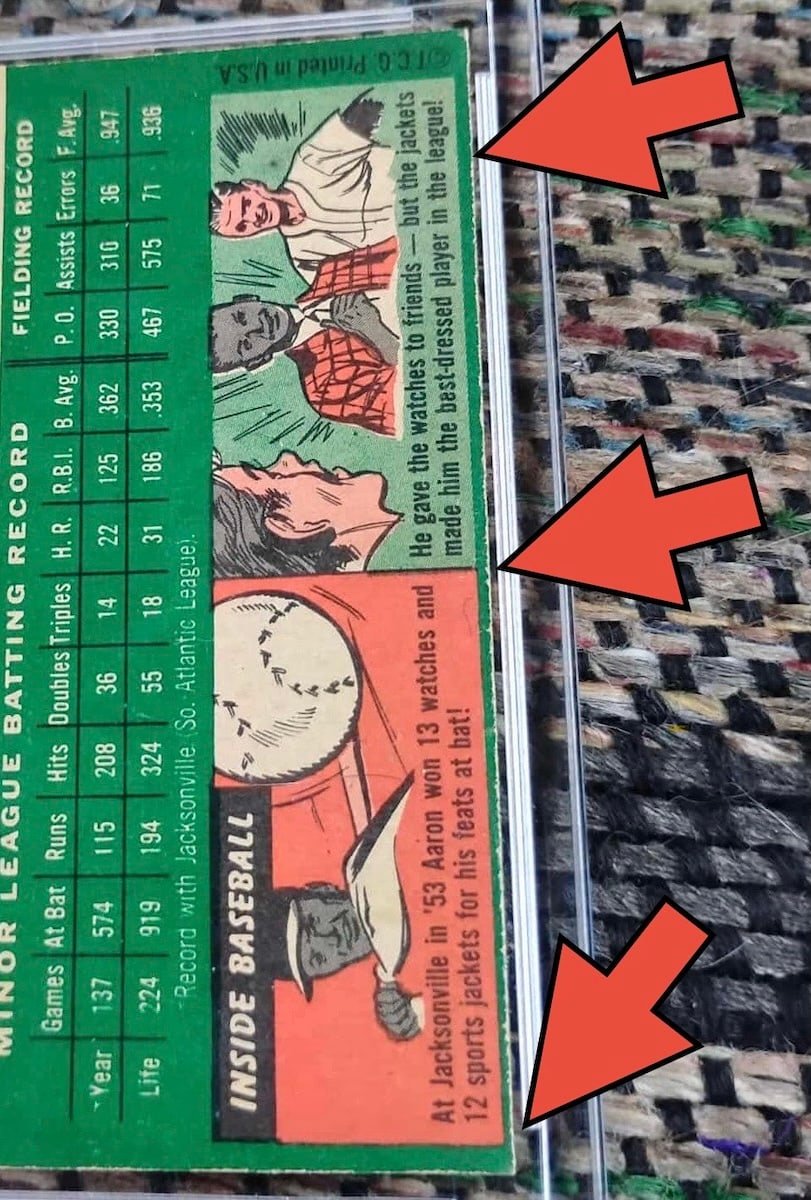
Two things there. The fraying, most visible from the back, is cardboard that got separated recently rather than seventy years ago. And a factory cut meets at a clean ninety degrees, where a card cut by hand tends not to. Look at how the edge gets just a bit wider right at the corner.
Why would anyone bother? Because on a card like this, one grade is worth thousands of dollars, and the trim costs nothing. Nobody trims a 1954 Wally Moon. The math only works on cards people want, which is why the tells matter most on the card you’re most excited about.
Two things that feel like proof, and aren’t
Somebody asked a fair question after I posted that thread: can’t you just measure it?
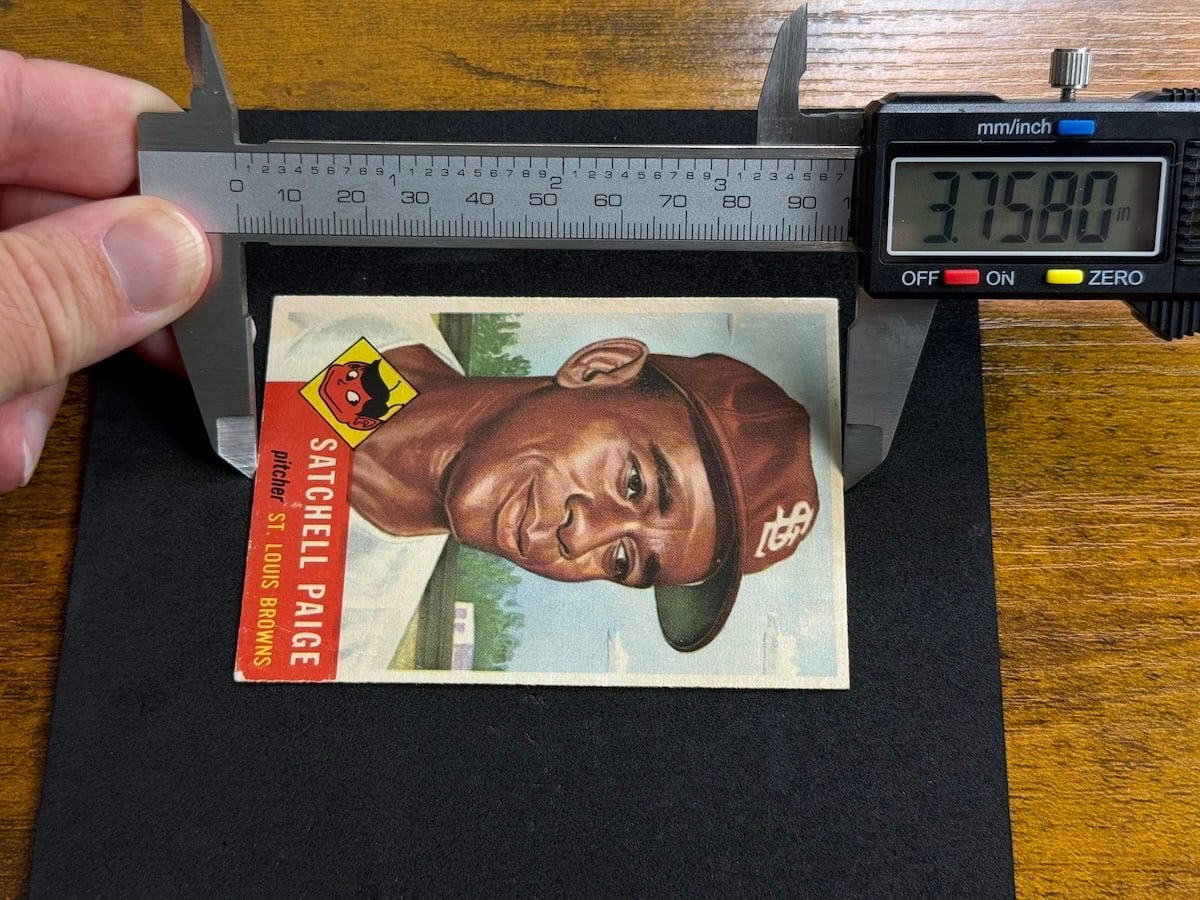
I do measure. I’ve started carrying digital calipers and they’re useful. They’re not proof.
The 1953 and 1954 Topps cards both ran 2 5/8 by 3 3/4 inches, and that Paige is right where it should be. The trouble is that Topps cut these on industrial presses with tolerances that would horrify a modern factory, so legitimate cards vary in both directions, coming out over and under the nominal size. A trimmer who starts from an oversized copy, or who shaves a single edge by a few thousandths, ends up holding a card that measures perfectly correct. And a genuine card that left the factory a shade small will read as suspicious to anyone with a caliper and a hunch. A correct measurement rules some things out. It proves nothing.
The opposite mistake is just as common, and somebody reading this is about to go squint at their own cards and frighten themselves over nothing.
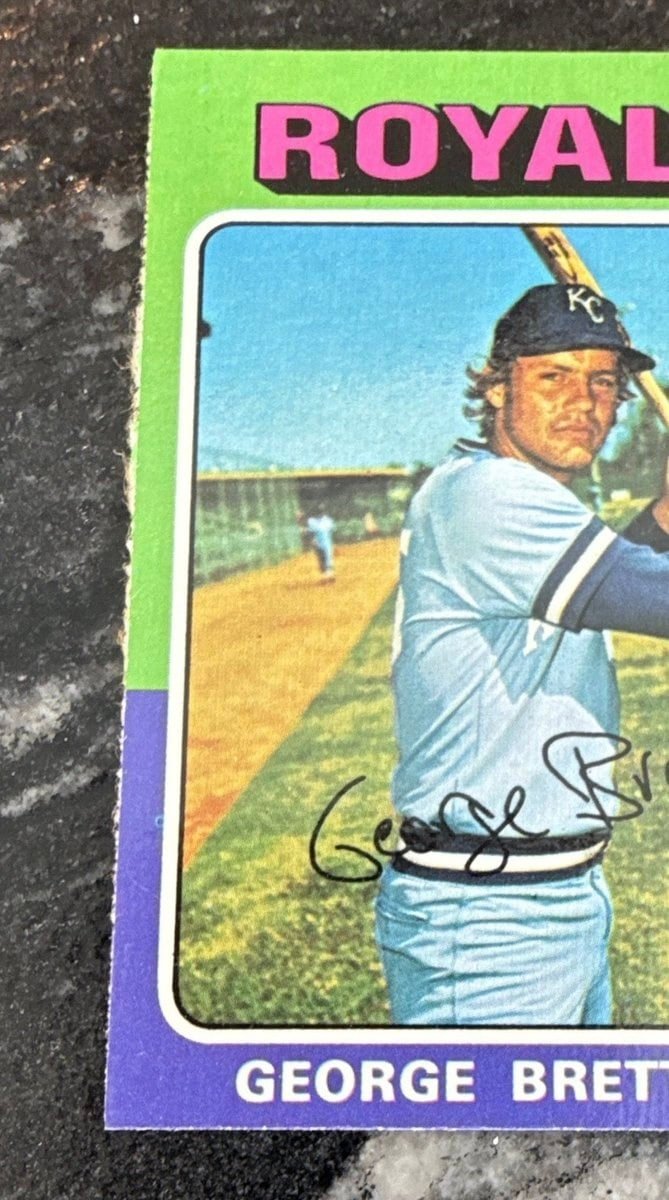
That edge is rough. It’s also completely legitimate. A dull factory blade leaves a ragged, chewed-looking edge like that one, and plenty of unquestioned cards in high grades look the same. A trim looks different from that, but not different in any way I can write down for you. It’s something you learn by handling a few thousand cards.
So measuring right doesn’t clear a card, and a rough edge doesn’t condemn one. Both instincts fail you, in opposite directions.
The card that looks too good for its age is the one I look at hardest.
Where these cards end up
That Aaron will sell to somebody. Maybe not for fifteen thousand, but for real money, to a person who looked at those photos and saw a beautiful card. It’ll go into a sleeve, into a box, into a closet.
And in twenty or thirty years it’ll come back out of that closet as an inheritance, and somebody’s kids will be sitting at a kitchen table across from someone like me.
That’s the drawer of counterfeits. Every card in it was somebody’s good card once. Whoever did the altering was long out of the story by the time the loss landed, and it landed on a family who’d done nothing but trust the person before them. I’d rather be the guy posting buyer-beware threads about strangers’ listings than watch one of these move quietly.
When I’m the one delivering it
“Your card has been trimmed” and “I would like to pay you less for your card” sound exactly the same coming out of a buyer’s mouth. You’re sitting at your own table with no way to tell which one you just heard. A dishonest buyer knows that perfectly well. It’s an extremely effective thing to say.
So don’t take my word for it. Put me through this instead:
- Make me point. Which edge, and what am I seeing there. “It looks trimmed” isn’t a read. “The back right edge is fraying and that corner isn’t square” is one, and you can go look at it yourself.
- Make me say it before the number. An honest read comes out while I’m still looking at the card. A convenient one shows up after the offer is on the table and you’ve hesitated.
- Ask whether I’d still buy it, and for what. A real assessment doesn’t change shape when you push on it. If my number moves around depending on how you react, I wasn’t reading the card.
- Send it in. Submit it to PSA or SGC. Plan on waiting: turnaround at the big graders is running months, not weeks, so this is a decision to make early rather than the week you want to sell. If I’m right, they’ll flag it. If I’m wrong, you’re holding a graded card worth more than it was when you woke up, and you should go tell everyone I was wrong.
That last one matters because I do get it wrong. Of the last fifteen cards I sent in myself, three came back without a numeric grade: two miscut, and one flagged as altered. I had handled all three of those cards and I’d been happy with all three. The graders were looking harder than I had.
The reason I say it anyway
Every one of these conversations costs me something. The easy version of my job is to say nothing, buy the collection at a number that quietly accounts for the bad card, and let the family stay happy with me. Plenty of people work that way.
I’d rather you heard it from me while you still own the card and can do something about it. Send photos and I’ll tell you what I see, including when what I see is bad news, and including when the answer is that a card belongs with a grader or an auction house rather than with me. If you’d sooner get your bearings first, here’s what these cards actually tend to sell for, and here’s why condition drives so much of the number.
Key takeaways
- Three kinds of bad news: the card that's common, the card that's fake, and the genuine card someone trimmed. The third is the costliest.
- On vintage, unusually clean for its age is a reason to look harder, not a reason to relax.
- Correct caliper measurements rule some things out. They don't prove a card wasn't trimmed.
- A rough, ragged edge is often just a dull factory blade, and perfectly legitimate.
- "Your card is trimmed" and "I want to pay you less" sound identical from a buyer. Make them point at the edge before they name a number.
Frequently asked questions
- How can you tell if a baseball card is fake?
- Counterfeits usually give themselves away on the card stock, which is too white, too thin, or too glossy for its age, and on the printing, which looks soft because it's a copy of a copy. Collectors also reach for three quick tests, and all three are weaker than their reputations. Holding a phone light behind the card is meant to expose a fake by how much shines through, but genuine stock varies and plenty of fakes are printed on convincing card. The print pattern under magnification can be a tell, though not always. Smell catches some reprints, but many counterfeits are old enough now that they smell like everything else in the box. All of it works best with a genuine card lying beside it, and a good fake beats every one of them.
- How do you know if a baseball card has been trimmed?
- The most common signs are fraying along the cut, usually most visible from the back, and corners that aren't square. A factory cut meets at a clean 90 degrees, while a hand-cut edge often widens slightly as it reaches the corner. A card that looks unusually sharp for its age is also worth a much closer look. Size on its own won't settle it, in either direction: vintage cards came off the presses both over and under the nominal dimensions, so a card that measures a little small may simply have been cut that way at the factory.
- Do digital calipers detect a trimmed card?
- Only sometimes. Calipers are useful and worth owning, but they aren't proof. Vintage cards were cut with wide tolerances, coming out both over and under the nominal size, so a card trimmed from an oversized copy can still measure exactly correct while a genuine card cut small at the factory can look suspicious. A correct measurement rules some things out and proves nothing.
- Is my 1987 Topps error card worth anything?
- Almost certainly not. Print runs from that era were enormous, and the smudges, miscuts, and missing letters people spot were repeated across tens of thousands of cards, so nearly every late-1980s and 1990s "error" is worth what the rest of the set is worth, which is very little. The real exceptions are documented and well known rather than something you discover yourself. The famous one is the 1990 Topps Frank Thomas No Name on Front, card 414 with his name missing from the front of the card, one of the most iconic cards of the decade and worth a large premium. Fittingly for this post, it's also faked by removing the name from an ordinary copy, which is a good part of why the graded ones carry the value.
- What should I do if I think a card in my collection is fake or altered?
- Don't clean it, press it, or try to fix anything, and don't sell it as authentic. Get a second opinion first. If the card would be worth four figures or more when genuine, submitting it to PSA or SGC is the only definitive answer. The fee is small next to the amount at stake, but turnaround currently runs months, so start early if you're planning to sell.