
How to Tell What Year a Baseball Card Is From

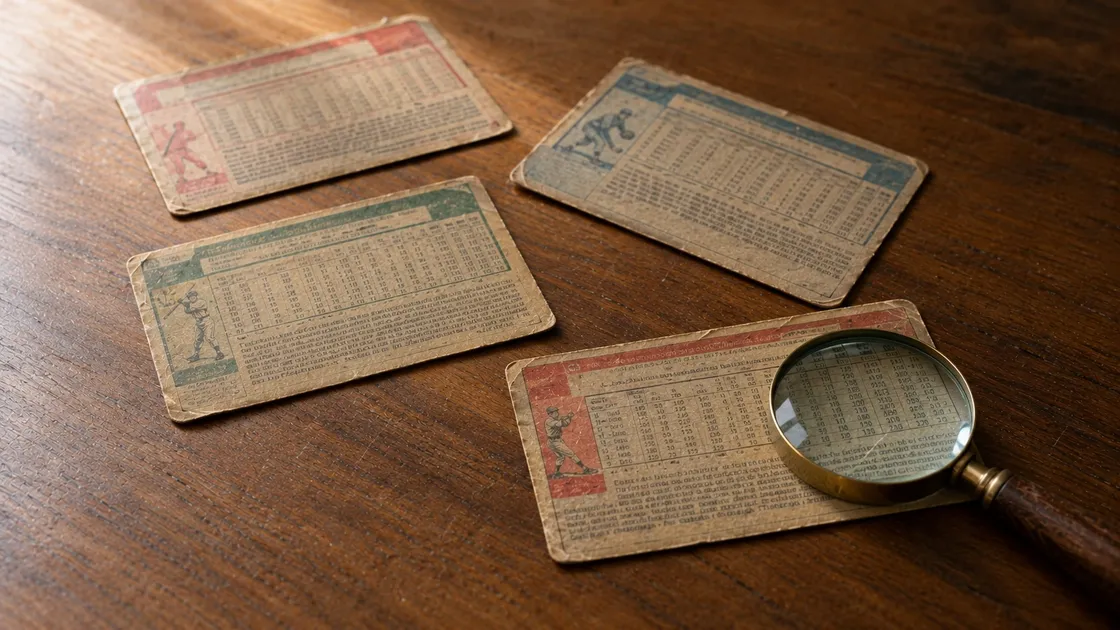
Here’s something nobody warns you about until you’re sitting on the floor with a box of somebody else’s cards: most of them don’t say what year they’re from.
It seems like an oversight. It isn’t. For most of this hobby’s history, cards were sold in the year they came out to kids who knew perfectly well what year it was. Printing a date would have been like printing the date on a newspaper you were reading that morning. The year only started appearing on cards routinely once the hobby became a collectibles market, decades after most of what’s in your box was made.
Which is a problem, because almost everything about a card’s value starts with its year. Here’s how to get it.
| Where to look | What it gives you |
|---|---|
| Copyright line on the back | Usually the exact year. Try this first |
| Last season in the statistics | Add one. Reliable across nearly every set |
| The brand on the front | An era, sometimes a narrow one |
| Design and card stock | A decade, once you’ve seen a few |
Start with the copyright line
Turn the card over and read the very bottom edge, in the smallest print on the card. You’re looking for a line with a © in it, often alongside the manufacturer’s name or initials. Topps cards, for instance, carried the mark of Topps Chewing Gum for years.
If there’s a year in that line, you’re almost certainly done. It’s the printer telling you when they printed it.
This takes ten seconds a card and answers the question for a large share of any collection, so do it before anything else. A magnifying glass helps more than you’d expect; the print is tiny on some sets and seventy years of handling hasn’t improved it.
No copyright year? Use the statistics
This is the method that works when nothing else does, and it’s the one worth actually learning.
The back of most baseball cards carries the player’s year-by-year statistics. Find the most recent full season listed. Then add one.
That’s it. A card whose stat lines stop at 1961 is a 1962 card. The reason is simple: cards are printed and packed over the winter and sold into the coming season, so the newest numbers they can possibly carry are last year’s. A card issued for the 1962 season physically could not include 1962 statistics.
There are edge cases. A rookie with no professional seasons behind him may have only minor league lines or none at all, and some late-career cards list a career total instead of a final season. But across a whole box, this rule will date the overwhelming majority of what you’re holding.
The brand alone narrows it
Before you even turn the card over, the name on the front rules out whole decades.
- Topps — the long constant. Baseball cards from 1951 onward, which means the brand alone tells you very little. Everything else on this page still applies.
- Bowman — the early rival. Its original run ended in the mid-1950s when Topps bought it, and the name wasn’t used again for over thirty years. So a Bowman card is either old or fairly recent, with a long gap in between and no middle ground.
- Fleer — a brief early presence, then absent from mainstream baseball cards for a long stretch, then back from 1981.
- Donruss — 1981 onward. There is no such thing as a 1960s Donruss baseball card.
- Score, Upper Deck — later still, from the late 1980s.
If the front says Donruss or Upper Deck, you already know the card isn't from the era where the money is.
That last point does more work than any other single tell. A great many people open a box hoping for something from the fifties and are actually holding cards printed in the late eighties, and the brand name is the fastest way to find that out. If that’s what you’ve got, the honest picture of that era is worth reading before you get your hopes up — or before anybody makes you an offer.
There’s a fuller brand-and-era rundown on what I buy, which is arranged around exactly this question.
Be careful with a year printed on the front
Some cards do have a year right there on the front, and it’s often not the card’s year.
Design elements refer to the season just played: a card celebrating last year’s league leaders, a World Series subset, an All-Star card commemorating the previous summer. A “1961 World Series” card is a 1962 card. Treat any front-of-card year as a clue about what the card is about, then confirm the actual year from the back.
When there’s no back to read
Some of the most interesting cards in a collection have no statistics and no copyright at all: cards cut from cereal boxes, panels from the back of a product, regional issues given away at a local business. Those have to be dated by identifying the set rather than the card, which usually means matching the design against a reference or asking someone who’s seen them before.
Don’t dismiss these. Oddball and regional issues are among the cards most likely to be quietly valuable and most likely to be mistaken for junk, precisely because they don’t look like the cards people expect.
The bottom line
Copyright line first. Statistics second. Brand as a sanity check. That sequence will date nearly everything in a normal collection, and it’s satisfying once you get going. You’ll date a stack of thirty cards faster than you’d think.
You only need to do this properly on the cards that could matter, which mostly means the oldest ones. Once you know the year, you can look up what comparable copies have actually sold for and start to see the shape of what you have.
Or skip it. Send me photos of the fronts and backs and I’ll tell you what years you’re looking at, which is usually the first thing I do anyway.
Key takeaways
- Check the back first. The copyright line along the bottom edge is the fastest answer.
- No copyright year? Last season in the stats, plus one. That rule almost always holds.
- The brand alone narrows it fast — Donruss, Fleer and Score mean 1981 or later; Upper Deck means 1989 or later.
- A year printed on the front is usually part of the design, not the card's year — check it against the stats.
- Cards with no back at all — hand-cut, cereal box, regional issues — are dated by the set, not the card.
Frequently asked questions
- Why doesn't my baseball card have a year on it?
- Because for most of the hobby's history it wasn't necessary. Cards were sold in the year they came out to buyers who knew what year it was. Printing the year on the card only became common much later, so nearly every card made before the 1980s has to be dated from something other than a printed date.
- How do I date a card using the statistics on the back?
- Find the most recent full season listed in the stat lines. Cards are printed and sold ahead of the season they're issued for, so the card is almost always from the following year. A back whose last line reads 1961 is a 1962 card.
- Does the copyright year on the back always match the card's year?
- Usually, and it's the fastest check you have. Occasionally a copyright refers to a photo or a design element rather than the print run, so if the copyright and the statistics disagree by a year, trust the statistics.
- How can I tell an original vintage card from a later reprint?
- Reprints normally announce themselves somewhere on the back, often in small print, and the card stock usually feels and looks different from the original. If a card seems too clean for its age and the back has a modern gloss, that's worth taking seriously before anything else.