
Are 1970s Topps Cards Worth Anything?

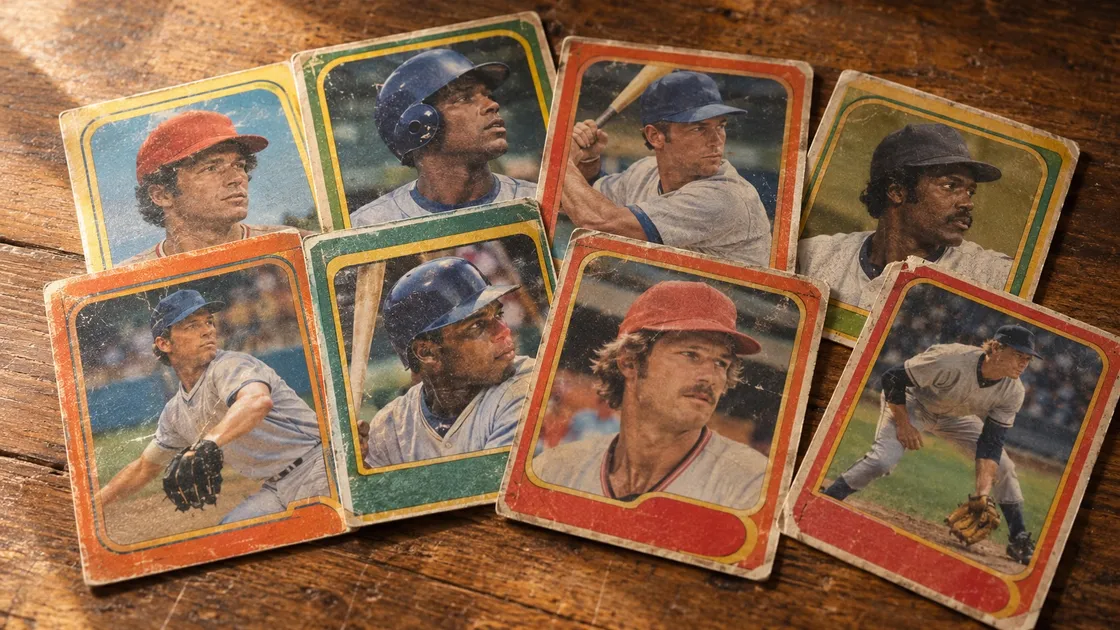
People are often a little deflated when I tell them their 1970s Topps aren’t worth much. Then they’re relieved when I tell them the cards aren’t worthless either. Both are true, and the gap between them is where this decade gets interesting.
If you’ve already read the honest answer about 1987 Topps, it’s tempting to assume the seventies are the same story with older dates. They aren’t. A 1987 card was printed by the billion and saved in mint condition by people expecting it to pay for college. A 1975 card was bought by a kid with pocket change, flipped against a wall, rubber-banded and stuffed in a shoebox. Far fewer survived, and far fewer survived in good shape.
So the seventies are real vintage. They’re just vintage in large numbers.
| 1970–1973 | 1974–1979 | |
|---|---|---|
| How Topps sold them | In series, spring through late summer | The whole set at once |
| Scarce part of the set | The last series (high numbers) | Nothing printed short on purpose |
| What carries value | High numbers, stars, rookies, condition | Stars, rookies, condition |
What a typical 1970s card actually sells for
I keep records of everything I sell, and the seventies are the clearest example of a decade where almost everything sells and almost nothing sells for much. Most cards from the decade go for somewhere between a dollar and ten dollars. Clean star cards and the better rookies bring $25 to $70. Very few cards from the decade clear $100 raw. The exceptions are the key rookies in high grade, and they are the exception.
You can see those ranges for yourself, era by era, on the card values page. The short version for the seventies: a box of commons is worth something real, but it’s worth it as a box. Nobody pays card-by-card prices for a thousand 1977 commons, because nobody can sell them card by card fast enough to make it worthwhile.
That’s not bad news. It just means the value of a seventies collection lives in a handful of specific cards, and the job is finding them.
High numbers: the early-seventies scarcity
This is the one piece of 1970s knowledge that actually moves money, and most people have never heard of it.
Through 1973, Topps didn’t release the whole set in the spring. They released it in series, one batch after another, through the summer. By the time the last series hit stores in late summer, kids had moved on to football, school was coming, and stores were ordering less. So Topps printed fewer of them.
Those last-series cards, the high numbers, are scarcer today than the rest of the set, and collectors trying to finish a set pay a premium for them. If you have a 1970, 1971, 1972 or 1973 set, the highest card numbers in it matter more than the lower ones, even for players nobody has heard of.
In the early seventies, when a card was printed can matter almost as much as who's on it.
From 1974, Topps released the whole set at once. The high-number premium ends there, which is one reason the later seventies tend to be worth less card for card.
The rookies that carry the decade
If one card in a seventies collection is going to matter, it’s usually a rookie card. The short list:
- Mike Schmidt, 1973 Topps. The best third baseman of his era, and the decade’s most valuable mainstream rookie. It’s a shared card, with Schmidt pictured alongside two other rookies, so it’s easy to flip past.
- George Brett and Robin Yount, 1975 Topps. Both rookies in the same set, both Hall of Famers. The 1975 set is the one most collectors of the era remember, partly because of its two-color borders and partly because of these two cards.
- Eddie Murray, 1978, and Ozzie Smith, 1979. The late-decade names worth checking for.
Stars matter too. Nolan Ryan, Hank Aaron, Roberto Clemente, Willie Mays at the end of his career, Johnny Bench, Reggie Jackson. A clean card of any of them is worth pulling out of the box.
Centering: the decade’s real problem
Here’s what surprises people. A 1970s card is younger than a 1950s card, but it’s often harder to find in genuinely good condition.
Topps’ quality control in the seventies was rough. Cards were routinely cut off-center, so one border is thick and the opposite one nearly disappears. Print defects were common: little white specks, faded patches, color slightly out of register. A large share of seventies cards came out of the pack already imperfect.
So when you’re looking through a seventies collection, centering is the first thing to check on any card that could matter. A star card with even borders on all four sides is meaningfully more valuable than the same card cut badly, and if it’s ever graded, centering is often what limits the grade. What a grade actually means goes into why the difference between two grade points can be a multiple of the price.
Where the line falls for me
I buy through 1975. That covers the high-number years, the Schmidt rookie and the 1975 set with Brett and Yount, which is most of where the decade’s value is.
For 1976 through 1979, I’ll still look at photos and tell you honestly what’s there and roughly what it’s worth. If there’s a reason to sell those cards somewhere other than to me, I’ll tell you where. That’s the same thing I’d tell you about anything outside what I buy.
If you’re not sure what year a card is, the back usually tells you within about ten seconds.
The bottom line
1970s Topps cards are worth something. Most are worth a few dollars, and a box of them is worth more as a box than as a list. The money concentrates in three places: the early-seventies high numbers, the star rookies, and any card whose centering and corners have held up. Those are the ones to pull out and look at closely.
If you’d rather not sort through it, send me photos of the stack, fronts first. I’ll tell you which cards are the ones worth caring about.
Key takeaways
- 1970s Topps are real vintage. Most cards sell, but usually for a few dollars each, not tens.
- Early in the decade, the last series of the year (the high numbers) was printed in smaller runs and is scarcer today.
- Star rookies carry the decade: Mike Schmidt (1973), George Brett and Robin Yount (1975).
- Centering and print quality were rough in the seventies, so a genuinely clean copy is worth noticeably more.
- 1971's black borders show every nick, which makes that year unusually hard to find in high grade.
Frequently asked questions
- What are high-number cards in 1970s Topps sets?
- Through 1973, Topps released each year's set in series over the spring and summer. The final series, the highest card numbers, came out late in the season when fewer packs were being bought, so fewer were printed and fewer survive. From 1974 Topps issued the whole set at once, which ended the high-number premium.
- Which 1970s Topps rookie cards are worth the most?
- The 1973 Mike Schmidt and the 1975 George Brett and Robin Yount are the headline rookies of the decade. Later in the seventies, Eddie Murray (1978) and Ozzie Smith (1979) are the other names to look for. Condition decides the price far more than the name does.
- Why are 1971 Topps cards hard to find in good condition?
- The 1971 set has solid black borders. Any chip, rub or soft corner shows up as a white mark against the black, so wear that would be invisible on a white-bordered card is obvious on a 1971. Clean copies exist, but there are far fewer of them than for the years around it.
- Is a complete 1970s Topps set worth more than the loose cards?
- Usually, yes. A complete set saves a collector years of hunting, and it carries the stars and rookies with it, so it typically sells for more than the same cards would bring one at a time. A near-complete set is still worth keeping together rather than splitting up.