How Do I Know If It's a Rookie Card?

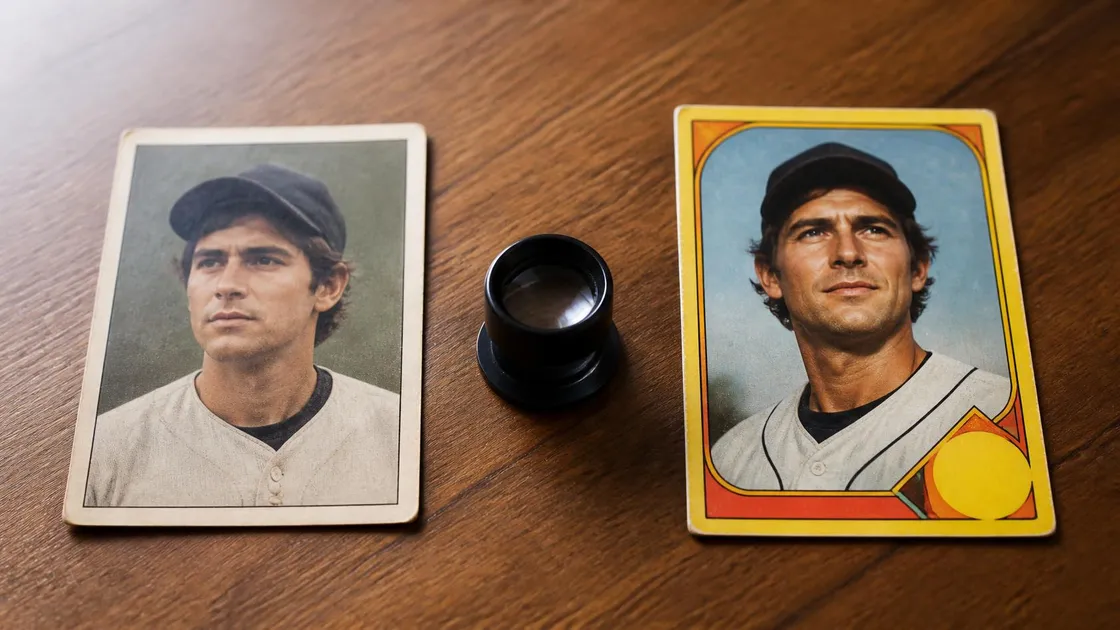
“Is it a rookie card?” is one of the first questions people ask me about a card, and with good reason. For any player who went on to matter, the rookie card is usually the most valuable card of his career. Sometimes by a lot.
The trouble is that on anything older than the mid-2000s, nothing on the card tells you. Modern cards carry a small “RC” logo, an official mark that tells you exactly what you’re holding. A 1960s or 1970s card has no such thing. You have to work it out from the card itself.
It’s not hard once you know where to look. Here’s the method I use.
| What to check | What it tells you |
|---|---|
| Statistics on the back | How much major league history the player had. Little or none points to a rookie card |
| The heading on the front | “Rookie Stars,” “Rookie Pitchers” and similar mean a shared rookie card |
| The trophy symbol | An award for last season. Usually the second card, not the first |
| The brand and year | Whether it’s the player’s first major, nationally sold card |
First, what counts as a rookie card
The hobby’s working definition is a player’s first card in a major, nationally sold set. That means mainstream manufacturers’ regular sets, the cards sold in packs across the country.
That rules a few things out, which surprises people. A minor league card from before the player reached the majors isn’t usually called his rookie card. Neither is a card from a regional issue sold in one city, or a cereal-box card, even if it came out first. Those can be interesting, and a few are valuable in their own right, but when a collector says “the rookie card,” they almost always mean the first mainstream one.
The famous example is Mickey Mantle. Plenty of people believe the 1952 Topps Mantle is his rookie card. It isn’t. His rookie card is the 1951 Bowman, the year before. The 1952 Topps is his first Topps card, which is a different and also very valuable thing. Getting that distinction right matters when you’re looking up what a card has sold for, because the two trade at very different prices.
Turn it over: the statistics test
This is the fastest and most reliable check, and it uses the same skill as dating a card from its back.
Look at the player’s year-by-year statistics. A rookie card is printed before or during the player’s first real season, so the back shows very little major league history. Typically that’s one of three things:
- No major league lines at all, just minor league numbers.
- A single short major league line, a late-season call-up of a few games.
- A sentence or two of biography instead of a stat table.
If the back shows four or five full major league seasons, it isn’t the rookie card, however young the player looks on the front. His rookie card is a few years earlier.
The shared-card trap
This is where people miss the cards that matter most.
For decades, Topps often didn’t give new players their own card. Instead, it put two, three or four rookies on a single card under a heading like “Rookie Stars” or “Rookie Third Basemen,” each with a small head-and-shoulders photo. Most of the players on those cards had short careers. Now and then, one of them became a Hall of Famer.
Some of the most valuable rookie cards in the hobby look exactly like that:
- Pete Rose, 1963 Topps — four rookies on one card.
- Nolan Ryan, 1968 Topps — shared with Jerry Koosman.
- Mike Schmidt, 1973 Topps — shared with Ron Cey and John Hilton.
The most valuable card in the box can be the one with four strangers' faces on it.
Because they look busy and unfamiliar, shared rookie cards are the ones people flip past or leave in the bulk. When you’re going through a collection, pull out every multi-player card and read the names. If you’re working through a seventies box in particular, the decade’s key rookies are mostly on cards like these.
The trophy that fools people
From 1960 on, some Topps cards carry a small trophy symbol. It’s tempting to read it as a rookie card marker. It’s actually the opposite.
The trophy marks a player named to Topps’ All-Star Rookie team for the season just finished. Since cards are printed after the season, that trophy appears on the card issued the following year, which is usually the player’s second card. The trophy tells you the player had a good rookie season. His rookie card is the year before.
When a rookie card actually matters
Finding a rookie card isn’t the same as finding a valuable card. The rookie premium only applies to players who went on to matter. Every player in history has a rookie card, and for most of them it’s worth what any other card of that player is worth, which is usually very little.
What you’re really looking for is the overlap: a rookie card of a star. When you find one, condition decides almost everything. A Hall of Famer’s rookie card with sharp corners and good centering is worth many times a worn copy of the same card, and that’s exactly the kind of card where a grade can make sense.
You can see how rookies and star cards stack up against the rest of a collection, era by era, on the card values page.
The bottom line
Vintage rookie cards don’t announce themselves. Turn the card over and look for a back with little or no major league history. Check the front for a shared “Rookie Stars” card. Ignore the trophy, which belongs to the year after. Then ask whether the player became somebody, because that’s what turns a rookie card into a valuable one.
If you think you’ve found one, photograph the front and back in good light and send them over. I’ll tell you whether it’s the rookie card, and if it’s the kind of card I’m after, what I’d pay.
Key takeaways
- Vintage rookie cards don't say 'rookie' anywhere. The official RC logo only arrived in the mid-2000s.
- The back is the fastest test: little or no major league history in the stats usually means the rookie card.
- Many great players debuted on shared cards, three or four rookies to a card, under a heading like 'Rookie Stars.'
- The Topps rookie trophy is usually on a player's second card, not the first. It's an award for last season.
- A first card isn't automatically the rookie card. The hobby counts the first major, nationally sold set.
Frequently asked questions
- What counts as a player's rookie card?
- The hobby generally treats a player's rookie card as his first card in a major, nationally distributed set from a mainstream maker like Topps, Bowman or Fleer. Earlier minor league cards, regional issues and oddball cards can be interesting and even valuable, but they're usually not what collectors mean by 'the rookie card.'
- Does the trophy on a Topps card mean it's a rookie card?
- Usually not. The little trophy marks a player named to Topps' All-Star Rookie team for the season before, so it appears on the card issued the following year. That's normally the player's second card. It's a sign of a good rookie season, not a rookie card.
- Can a player have more than one rookie card?
- Yes. When two major makers both issued cards in a player's first year, both are rookie cards, and collectors argue over which matters more. In the 1950s that usually means a Topps and a Bowman card from the same year. Later, it often means Topps, Fleer and Donruss all in one season.
- Why is a rookie card usually a player's most valuable card?
- Because it's the first, and collectors chasing a great player want the beginning. It also tends to be the scarcest, since nobody knew yet who the player would become and few people saved those cards carefully. The premium only applies to players who went on to matter, though. A forgotten player's rookie card is just a common.