Will a Pawn Shop Buy Baseball Cards?

Short answer: yes, most pawn shops will take baseball cards. The better question is whether you want them to.
I’ll be upfront that I’m not a neutral party here. I buy cards too, so a pawn shop is technically my competition. Still, it’s worth understanding how a pawn offer gets put together before you carry a box through the door. A pawn shop isn’t doing anything wrong when it makes you a low offer. It’s doing exactly what a pawn shop is built to do. That just isn’t what an old card collection needs.
I’ve written before that a pawn shop is the one local option I’d skip. This is the longer version of why, and the one exception.
| Pawn loan | Pawn sale | |
|---|---|---|
| What happens | Cards held as collateral; you get them back by repaying | Shop buys the cards outright |
| What you get | A loan, usually small | A one-time payment |
| What it costs | A fee for every month the loan runs | The gap between their offer and the cards’ value |
| If it goes wrong | You don’t repay, they keep the cards | Nothing to go wrong; the cards are gone |
| Makes sense when | You need cash briefly and want the cards back | Rarely |
Two different deals: the loan and the sale
When you bring cards to a pawn shop, you’ll usually be offered one of two things, and it helps to know which one you’re agreeing to.
A pawn loan. The shop lends you money and holds your cards as security. You get a ticket with the loan amount, the fee and a deadline. Repay the loan and the fee before the deadline and you get your cards back. If you don’t, the shop keeps them and sells them. There’s no further debt and, usually, no mark on your credit. You simply lose the cards for the amount you borrowed.
An outright sale. The shop buys the cards and that’s the end of it. Shops often offer a little more to buy than to lend, because they don’t have to hold your cards and wait to see whether you come back.
Why the number is what it is
Here’s the thing people take personally and shouldn’t. A pawn shop’s offer on cards is low for straightforward business reasons.
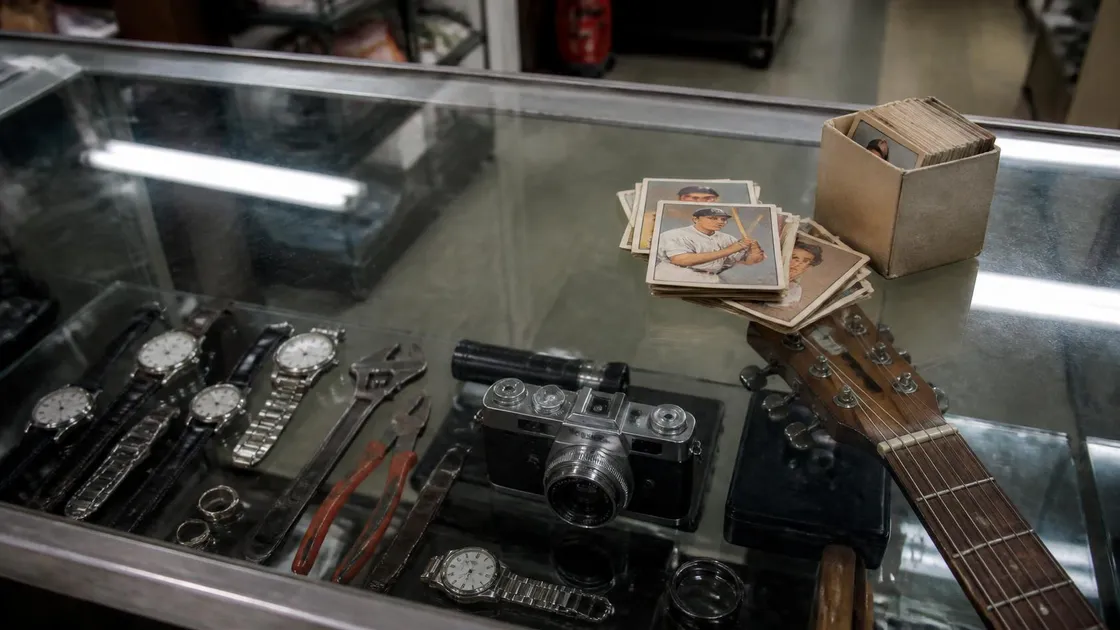
A pawn shop buys everything: watches, tools, guitars, jewelry, cameras. It makes money by buying for less than it can sell for, quickly, to whoever walks in. To do that safely across that many categories, it has to price conservatively on anything it can’t fully judge.
Old baseball cards are about as hard to judge as anything that comes through the door. The difference between a $5 card and a $500 one can be the year, the player, a reprint mark on the back, or a crease you only see when you tilt it to the light. Very few pawn shops have anyone who can make those calls. So the sensible move, from their side, is to price the whole stack as “old cards” and assume the worst about condition.
A pawn shop isn't underpaying you for the cards it understands. It's protecting itself from the ones it doesn't.
For a box of ordinary commons, that may not cost you much, because the cards really are worth very little one at a time. For a collection with a few genuinely good cards in it, it costs you exactly those cards. The valuable ones get averaged into the rest, and nobody at the counter notices the difference. That’s the same thing that happens with any buyer who doesn’t separate the good cards from the bulk. A pawn shop is just the most extreme version of it.
The one time it makes sense: a short loan
There is a situation where a pawn shop is the right call, and it’s specific.
If you need cash for a few weeks, you’re confident you’ll have it back soon, and you want to keep the cards, a pawn loan can be a reasonable bridge. You’re not selling anything. You’re borrowing against the cards, paying a fee for the privilege and collecting them afterwards. Compared with selling a collection you’d rather keep, at a price set by urgency, that can be the better trade.
It only works if all three of those things are true. If the loan runs month after month, the fees eat into whatever you saved by not selling. If there’s a real chance you won’t repay, you’re effectively selling the cards for the loan amount, which is usually the lowest number anyone would have given you.
Why I’d sell somewhere else
If you want to sell outright, nearly any other buyer who knows cards will do better than a pawn shop, because they can actually see what’s there. That includes a local card shop, a dealer at a show, an auction house for the very best cards, and private buyers like me.
What matters is that whoever makes the offer can tell your cards apart, and will show you how they got to their number. A fair cash buyer still pays less than retail, and that gap is normal. But it should be a gap you can see and understand, not a flat price for a box nobody looked inside.
Before you take anything anywhere, it helps to know roughly what you have. The card values page shows what cards from each era actually sell for, which gives you something to measure any offer against, pawn or otherwise.
The bottom line
A pawn shop will almost always take your cards, as a loan or a sale. As a sale, it’s usually the lowest offer you’ll get, not because anyone is cheating you but because the shop can’t afford to guess right on cards it doesn’t know. As a short loan, it can genuinely help if you need cash briefly and want the collection back.
If you’re selling, get an informed opinion first. Take a few good photos and send them to someone who knows vintage cards. That’s exactly what the free valuation is for, and I’ll tell you honestly if the pawn shop’s number is closer than I’d expect.
Key takeaways
- A pawn shop can lend against your cards or buy them. They're different deals with different math.
- The offer is low for a sensible reason: the shop is pricing for a fast resale, not for what a collector would pay.
- Most pawn shops don't have anyone who can separate a valuable vintage card from an ordinary one, so the good cards get averaged down.
- A pawn loan can be a reasonable bridge if you need cash for weeks, not months, and you're sure you'll repay it.
- Get a number from someone who knows cards first, so a pawn offer can't set your expectations.
Frequently asked questions
- Can I pawn baseball cards instead of selling them?
- Many pawn shops will make a loan against cards. The shop holds the cards as collateral, and you get them back by repaying the loan plus a fee before the deadline on your ticket. If you don't repay, the shop keeps the cards and sells them. Loan amounts on cards tend to be modest, because the shop is lending against what it could resell them for quickly.
- How much will a pawn shop pay for baseball cards?
- Typically a small fraction of what the cards would bring from a collector. The shop has to hold them, find a buyer, and absorb the risk of having misjudged them, and most shops have no specialist to tell a scarce card from a common one. Expect an offer priced for a quick resale, not for the cards' real market value.
- What happens if I can't repay a pawn loan on my cards?
- The shop keeps the cards and sells them, and that ends the deal. It won't usually affect your credit, but you lose the cards for the amount of the loan, which is usually well below what they were worth. That's the real risk, and it's why a pawn loan only makes sense if you're confident about repaying.
- Is a pawn shop offer a good way to find out what my cards are worth?
- No. A pawn offer tells you what that shop would pay to resell quickly, not what the cards are worth to a collector. The two can be far apart, especially for older cards. Get a read from someone who knows vintage cards before you treat any offer as a benchmark.