
Selling Baseball Cards for Cash: What to Expect

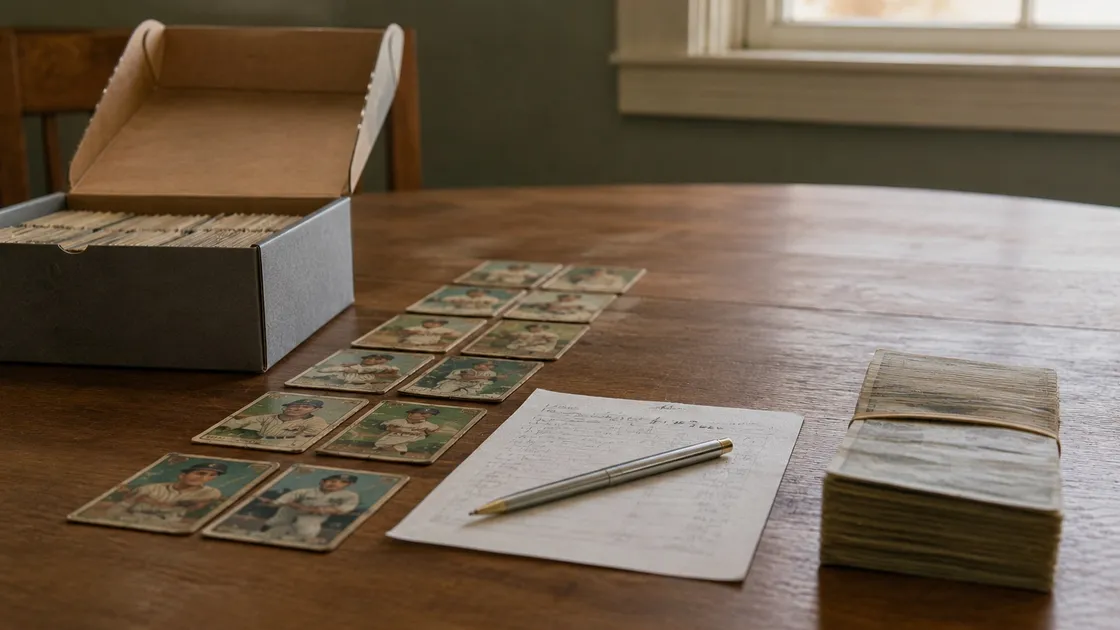
“Sell baseball cards for cash” gets searched a lot, and it usually means somebody has decided to be done. Fair enough. It’s also the transaction nobody bothers to explain, so here’s what happens and what a fair version of it looks like.
Cash means one payment, today, for the whole thing. No listings. No fees. No waiting around to find out whether anything sells. You hand over the cards, you get paid, you’re finished.
What you give up is top-line price. The rest of this is about how much you should be giving up.
Why a cash offer sits below retail
Whoever pays you has to sell the cards afterwards. That means marketplace fees, mailers, hours of listing, storage for the slow stuff, and the risk that a chunk of it just sits there. The difference between what your cards eventually sell for and what you got paid covers all of that, plus their profit.
The gap isn’t a trick. It’s the reason someone can hand you money today instead of in eight months. Nobody pays full retail and stays in business very long.
What matters is how big the gap is, and whether they’ll say.
Every buyer has a margin. The good ones tell you how big it is.
What a fair offer looks like
No single percentage covers it. It depends on how fast the buyer can move what they’re taking.
Bulk commons — the junk-wax layer, unsorted boxes, binders of 1988 Donruss — bring a small fraction of retail. Retail on those is close to nothing to begin with. Most of them are worth cents, so a low number there is usually just reality showing up.
Mid-grade vintage, meaning your 1960s and ’70s commons and minor stars, lands in the middle. It sells steadily. It also sells slowly.
Strong pre-1980 cards are the other end: stars, rookies, scarce issues, anything in high grade. Those should bring a much bigger share of what they resell for, because a buyer can move them in a week rather than a year.
So one blended “percentage of book” across an entire collection is a small red flag. A collection isn’t one thing. Anyone who has really looked will price it in parts.
Honestly, the percentage matters less than whether the buyer can tell you what each part resells for. If they can, you can judge the offer yourself. If they won’t, you can’t, and no amount of arguing about the number will fix that.
How the money changes hands
Small amounts, physical cash is normal and fine. Anything substantial usually settles by instant bank transfer, Zelle mostly, or a cashier’s check. Be wary of a personal check for a large sum. That’s someone asking you to carry their risk for them.
Two rules either way.
The money clears before the cards leave your hands. Not “I’ll send it tonight.”
And write something down. Two lines does it: the date, a sentence on what was sold, the amount, both names, both signatures. Each of you photographs it. This protects the buyer as much as you, and anyone who resists it has told you something useful.
Meeting a stranger
Most advice skips this part, and it shouldn’t.
Meet in public, during business hours. A bank lobby is close to ideal: cameras, staff, and you can deposit the money before you’ve left the building.
Don’t go alone if the collection is worth real money. Don’t let a buyer come to your house for a first meeting, particularly if you’ve posted online that you own something valuable. If the collection is too big to haul and somebody does have to come to you, have another person in the house.
Count the money before anything is handed over.
None of that should offend a legitimate buyer. I’d expect all of it from anyone dealing with me. Someone who bristles at ordinary caution has just answered a question you were going to have to ask anyway.
When cash is the right trade
Take it when the collection is mostly common and mid-grade, when there’s a lot of it, or when you’d rather handle this once than administer it for six months. For bulk, the realistic alternative was never retail. It’s selling it as a lot anyway, after you’ve spent the hours finding that out.
Don’t take it when one or two cards carry most of the value. That’s where the gap is widest and most worth closing yourself, either by listing them or sending them to auction.
Most collections land on a split. Sell the two or three good cards properly, take one payment for the rest.
What I do
I buy collections for cash, so hold me to everything above.
I’ll tell you what I think your cards resell for and what I’d pay, and you’ll see the gap between the two. I take the common cards along with the good ones. And when something in your box would net you more sold another way, I’ll say so and tell you how to do it. That’s the promise, and it has cost me deals I’d rather lose than win badly.
Want to know what these cards tend to sell for before you talk to anybody? The range explorer is a decent place to start.
Key takeaways
- You're buying speed and certainty, and paying for them out of the top-line price.
- A fair buyer states what they think it resells for and what they're paying — the gap is the margin.
- Rough shape: bulk commons go for a fraction of retail; strong vintage should be a much higher share.
- Meet in a public place, count the money before the cards leave your hands, write a two-line receipt.
- Never ship first and get paid later. That's not a cash sale, it's a hope.
Frequently asked questions
- How much cash should I expect for a baseball card collection?
- It depends far more on what's in it than on how big it is. Bulk common cards bring a small fraction of retail because the buyer has to store and slowly move them; strong pre-1980 cards should bring a much higher share. Anyone quoting a figure before looking is guessing.
- Why is a cash offer lower than what the cards sell for online?
- Because the buyer then has to sell them — which costs fees, time, and the risk that some don't sell. That difference is their margin. The question isn't whether there's a gap, it's whether the buyer will tell you honestly how big it is.
- Is it safe to sell baseball cards for cash to a stranger?
- It can be, with basic precautions: meet in a public place such as a bank lobby during business hours, don't go alone, count the money before handing anything over, and write a short receipt both of you sign. Be wary of anyone who insists on meeting at your home.
- Should I take cash or sell the cards myself?
- Take cash for bulk and mixed collections, where listing individually isn't worth the hours. Sell yourself, or consign, when one or two cards carry most of the value — that's where the gap between retail and a cash offer is worth the effort of closing.