
My Cards Are All Commons. Is That Worth Anything?

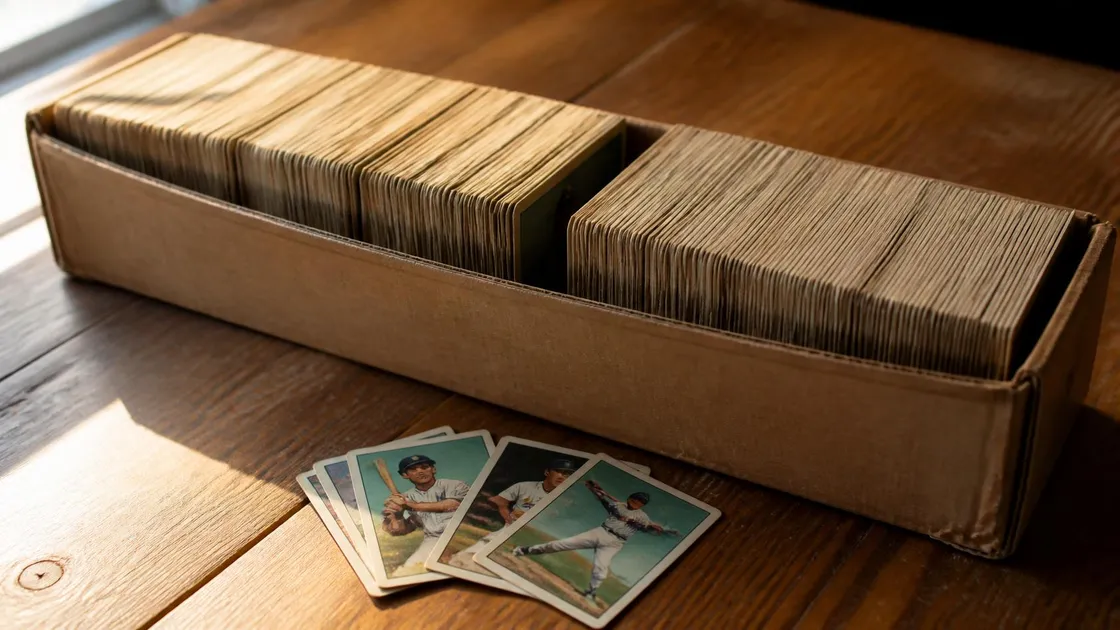
“There’s nothing good in here. It’s all commons.”
I hear that sentence a lot, usually from someone who has spent an evening looking for names they recognize, not found many, and concluded the box is a bust. Sometimes they’re right. Fairly often they’re wrong, and they’re wrong for an interesting reason: the word “common” is quietly doing two completely different jobs, and which one applies depends on when the cards were printed.
| The box is mostly… | Realistic per-card value | How it’s sold |
|---|---|---|
| 1950s–60s commons | Meaningful — dollars, not cents, in decent shape | Set-fillers, sold in year or team lots |
| 1970s commons | Modest but real | Year lots, sets, team lots |
| Late-80s–90s commons | Cents, and often not that | Bulk, by the box, if at all |
| Anything creased, taped or water-damaged | Little, at any age | Usually not worth handling |
What “common” actually means
A common is simply a card that isn’t a star, isn’t scarce, and isn’t a special subset: the ordinary card of an ordinary player. It’s a description of the card’s role in its set. It is not, and was never meant to be, a statement that the card is worthless.
The confusion comes from the fact that for one specific era, common really does mean close to worthless, and that era happens to be the one most people’s boxes are full of.
Why old commons are worth having
Here’s the thing that surprises people. A 1958 card of a player nobody outside his own family remembers is still a card somebody wants.
Two reasons. First, survival: those cards were bought by children and treated like the toys they were. They got flipped, rubber-banded, carried around, written on, and eventually thrown out by a parent. The proportion that made it to today in collectable shape is small, and it doesn’t matter that the card was mass-produced in 1958 if nearly all of them are gone.
Second, set collectors. A great many people in this hobby are working toward completing a set from a particular year, and completing a set means finding every card in it, including all the players nobody has heard of. Those collectors are patient, specific, and real. The scarce cards get all the attention, but the ordinary ones still have somewhere to go.
It doesn't matter how many were printed in 1958 if almost none of them are left.
The catch is condition, and it’s a real catch. Condition is most of a vintage card’s value, and that’s if anything more true for commons, where there’s no famous name compensating for a soft corner. A creased, rounded, sun-faded common is not the same proposition as a clean one from the same box.
Why later commons mostly aren’t
From the mid-1980s onward the picture inverts completely, and it’s worth being blunt about it.
The hobby had become an investment story by then. Cards were printed in vast quantities to meet demand, and — crucially — they were saved. Bought by adults, put straight into sleeves and boxes, and stored carefully in the belief that they’d be worth something one day. Which means that unlike the 1958 card, there is no survival problem at all. Mint copies are abundant, and abundant things are cheap.
That’s the whole of it, and I’ve written the honest version of that story at length. It’s not a scam and nobody did anything wrong. There are simply far more of those cards than there are people who want them.
How bulk is actually priced
Nobody prices a box of commons by looking up each card. It would take weeks and the answer wouldn’t justify the hours.
What a buyer actually does is establish the era, take a view on the average condition by going through a representative handful, check whether anything in there is complete or nearly complete, and then price the box as a box. Sets and near-sets matter here. A run of cards that’s 80% of a year is worth more than the same cards scattered, because it’s closer to something a collector wants.
Which means that if someone offers you a number for a box without leafing through much of it, they’ve either recognized the era instantly and are pricing conservatively for the unknowns, or they aren’t really looking. How they answer when you ask them to explain the number tells you which.
Don’t let the commons be separated
This is the practical point, and it’s the one worth remembering above the rest.
The valuable cards in a collection are what make anybody willing to take the ordinary ones. A buyer who acquires your four good cards and passes on the other three thousand has left you with the hardest part of the collection and nothing appealing attached to it. That remainder is hard to sell to anyone, at any price, and it’s why cherry-picking is the behavior I’d most want you to refuse.
So what do you do with them
If the commons are old, they’re part of the value and should be sold with everything else as one collection.
If they’re from the overproduction era, be realistic. Listing them individually costs more in time and fees than they return. They can go as one lot, they can go to a youth program or a school, or they can stay in the attic. But they aren’t a retirement fund and no honest person is going to tell you otherwise.
And if you don’t know which era you’re holding, that’s the first thing to sort out. Dating the cards takes an evening and changes the entire answer.
The bottom line
“All commons” is not a verdict. It’s a description that means something different in 1958 than it does in 1990, and the difference is the whole ballgame.
If your box is old, the ordinary cards in it are worth real, modest money and belong in the sale. If it’s from the boom years, the ordinary cards are ballast, and the useful question becomes whether anything in there breaks the pattern.
Send me photos — a wide shot of how they’re stored and a few closer ones, and I’ll tell you which of those two boxes you have. That takes me about five minutes and it’s free, including when the answer is that there isn’t much here. You can also see what vintage cards actually sell for by era to calibrate before you talk to anyone.
Key takeaways
- 'Common' means the card isn't a star or a scarcity — not that it's worthless.
- Pre-1980 commons have genuine per-card value, because most copies didn't survive.
- Late-1980s onward commons were printed and saved in enormous numbers, and price accordingly.
- Bulk is priced by the era and the average condition, not card by card.
- Don't let a buyer take the stars and leave you the commons. They are much harder to sell alone.
Frequently asked questions
- Are common baseball cards worth anything at all?
- Old ones, yes — modestly. A common card from the 1950s or 60s in decent shape is a card collectors actively buy, usually to fill a set. Commons from the late 1980s and 90s are a different story: they were produced in such quantity that they're generally handled as bulk rather than as individual cards.
- How much is a box of common baseball cards worth?
- It's priced on era, average condition and how complete anything in it is, rather than by counting cards. A box of 1960s commons in collectable shape is worth a genuine sum. A box of early-90s commons of the same size may be worth very little, however many cards are in it.
- Should I sell my commons separately from the good cards?
- Usually not. The valuable cards are what make a buyer willing to take the rest, so selling them separately tends to leave you holding the hardest part of the collection with nothing attractive attached to it.
- What should I do with commons nobody wants to buy?
- If they are from the overproduction era and have no market, the honest options are donating them to a youth program, school or hospital, passing them to a kid who will enjoy them, or leaving them where they are. Nobody is obliged to turn every card into money.