
What PSA 1 Through 10 Actually Mean

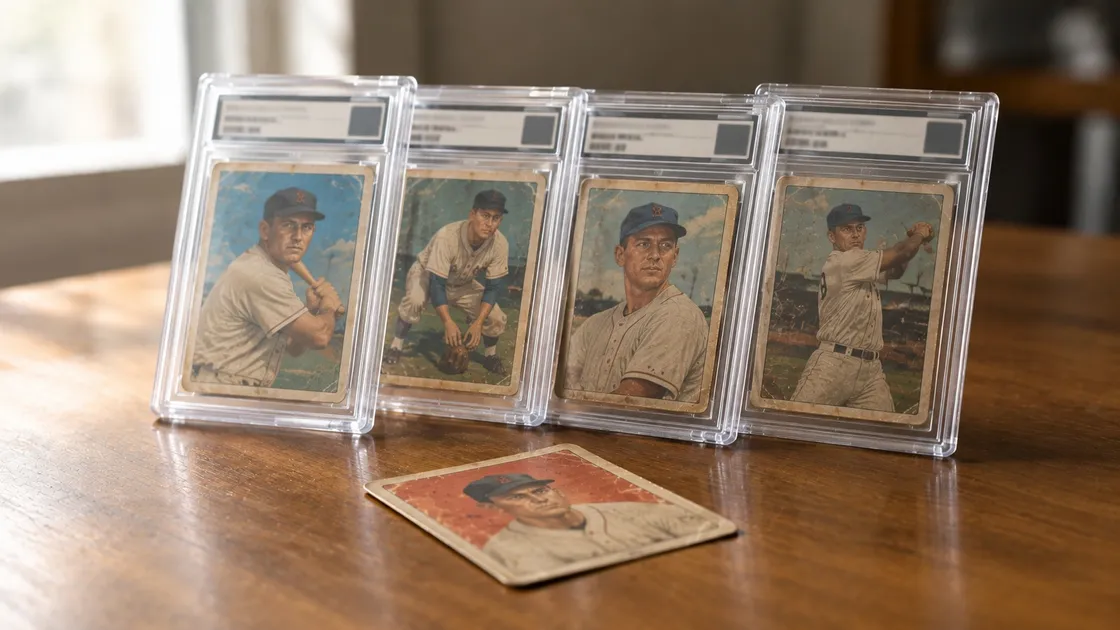
Sooner or later, somebody in this hobby is going to say a number at you. “It’s a PSA 7.” And unless you know what that means, you’re being handed the conclusion of an argument without seeing any of it.
So this is the scale, in plain English. Not whether you should pay to have your cards graded. That’s a different question with a real answer, and for most cards the answer is no. This is just how to read the number when you’re looking at one.
| Grade | Name | What it means in the hand |
|---|---|---|
| 1–1.5 | Poor / Fair | It’s been through something. Creases, rounding, maybe a tear or a missing corner |
| 2–3 | Good / Very Good | Obvious wear, soft corners, probably a crease. Still whole and displayable |
| 4–5 | VG-EX / Excellent | Light corner wear, some centering or surface issue. The normal range for vintage |
| 6–7 | EX-MT / Near Mint | Sharp-looking, minor flaws you have to look for |
| 8 | NM-MT | One small flaw at most. Genuinely uncommon on pre-1970 cards |
| 9–10 | Mint / Gem Mint | Essentially as it left the factory. On vintage, rare enough to be an event |
Where the number comes from
A grader looks at four things, and any one of them can cap the card on its own.
Centering — how evenly the image sits inside the borders. This is the one that surprises people, because a card can be otherwise flawless and still be capped at a 6 because the printing was off by a millimeter in 1962. That wasn’t the card’s fault or anyone’s, but the scale doesn’t care.
Corners — sharp, or soft, or rounded. This is what fingers do over decades.
Edges — chipping and white flecks, which show up brutally on the dark borders of certain sets.
Surface — creases, scratches, print marks, gloss, and any indentation from something having been stacked on it. Creases are the most value-destroying flaw there is, and the ones that matter most are often invisible until you tilt the card under a light.
A vintage 5 is a normal card
I want to be emphatic about this, because people hear “5 out of 10” and think their card failed an exam.
It didn’t. A 1957 card that has been in a shoebox in a closet for seven decades and comes back a 5 is exactly what a 1957 card should be. Kids owned these. They were sorted, flipped, rubber-banded, carried in pockets, and stuck in bicycle spokes. Most of them didn’t survive at all. The ones that did have honest wear on them, and the market prices them accordingly and buys them without complaint.
Why the money jumps
Here’s the part that actually matters if you’re selling.
Value doesn’t climb in a straight line up the scale. It climbs gently through the low and middle grades and then, somewhere around 7 to 8 on most vintage cards, it steps. A card that brings a couple of hundred in a 6 might bring twice that in a 7 and several times that in an 8.
The physical difference between those last two can be small: a corner you’d need pointed out to you. What’s not small is how many exist. Every grade up on a seventy-year-old card cuts the surviving population sharply, and by the time you reach 8 the buyers who want one are bidding against a very short list.
The difference between a 7 and an 8 is often a detail you'd have to be shown. The difference in price is not.
This is why looking up a sold price without checking the grade produces such wildly wrong numbers, and why comparing your raw card to any graded sale at all is a mistake.
The letters after the number
Sometimes a grade comes with a suffix: PSA 6 (OC), or 5 (MK). Those are qualifiers, and they’re a disclosure rather than a punishment.
- OC — off-center. The card is otherwise nicer than the grade suggests, but the centering is well outside tolerance.
- MK — a mark. Pen, pencil, a kid’s initials on the back.
- ST — a stain.
- MC — miscut, where the factory blade went somewhere it shouldn’t.
A qualified card usually sells below an unqualified one at the same number, and that’s fair enough. But it’s not a bad thing to see on a slab. It means the specific fault is stated on the label instead of waiting to be discovered by you.
PSA isn’t the only one
PSA is the largest and the most quoted, which is why this post uses its numbers. SGC uses the same 1–10 structure and is very well regarded on vintage in particular; plenty of serious vintage collectors prefer it. Beckett also grades on a 1–10 scale.
The three don’t grade identically, and prices for the same card at the same number can differ between them. For vintage, PSA and SGC are the two you’ll see most, and either is a real answer from a real examination.
The bottom line
Low numbers mean a card that got used. Middle numbers are the normal outcome for anything old. High numbers are scarce because survival is scarce, and the money reflects the scarcity rather than the visible difference.
You don’t need to grade your own cards to use any of this. You need it so that when a number is quoted at you — in an offer, in a listing, in a comparison someone is making to your card — you can tell whether it applies.
If you’d like someone to look at what you have and tell you honestly where it sits, send me photos. I’ll tell you which cards would be worth grading and which wouldn’t, and those are usually fewer than people expect.
Key takeaways
- 1–2 is heavily worn, 3–5 is the ordinary range for surviving vintage, 6–7 is nice, 8+ is genuinely scarce on old cards.
- A vintage 5 is not a bad card. It's a normal card, and it sells perfectly well.
- Value does not climb evenly with the grade. It jumps, usually somewhere around 7 to 8.
- Centering alone can cap a card's grade no matter how sharp everything else is.
- A letter after the number (OC, MK, ST) means the grade carries a specific, disclosed flaw.
Frequently asked questions
- What does PSA 8 mean on a baseball card?
- Near Mint to Mint. Sharp corners, strong color, no creases, and centering that's close to even, with maybe one minor flaw visible on close inspection. On a card from the 1950s or 60s an 8 is uncommon, because very few copies survived seventy years in that shape.
- Is a PSA 5 a good grade?
- For a vintage card, yes — it's an ordinary, honest, entirely sellable card. Expect light corner wear and some surface or centering imperfection. Most cards that have been in a shoebox since the sixties grade somewhere in this range, and collectors buy them happily.
- Why is a PSA 8 worth so much more than a PSA 7?
- Because the supply falls off a cliff. Each grade up on an old card means far fewer surviving copies, so the buyers competing for them are bidding against a much shorter list. The physical difference between the two cards can be small; the difference in how many exist is not.
- What do the letters after a PSA grade mean?
- They flag a specific known flaw so it isn't hidden: OC is off-center, MK is a mark such as pen or pencil, ST is a stain, MC is miscut. The card is graded as it is and the qualifier tells you which fault is doing the limiting.