
What Are My Baseball Cards Worth? How to Look It Up

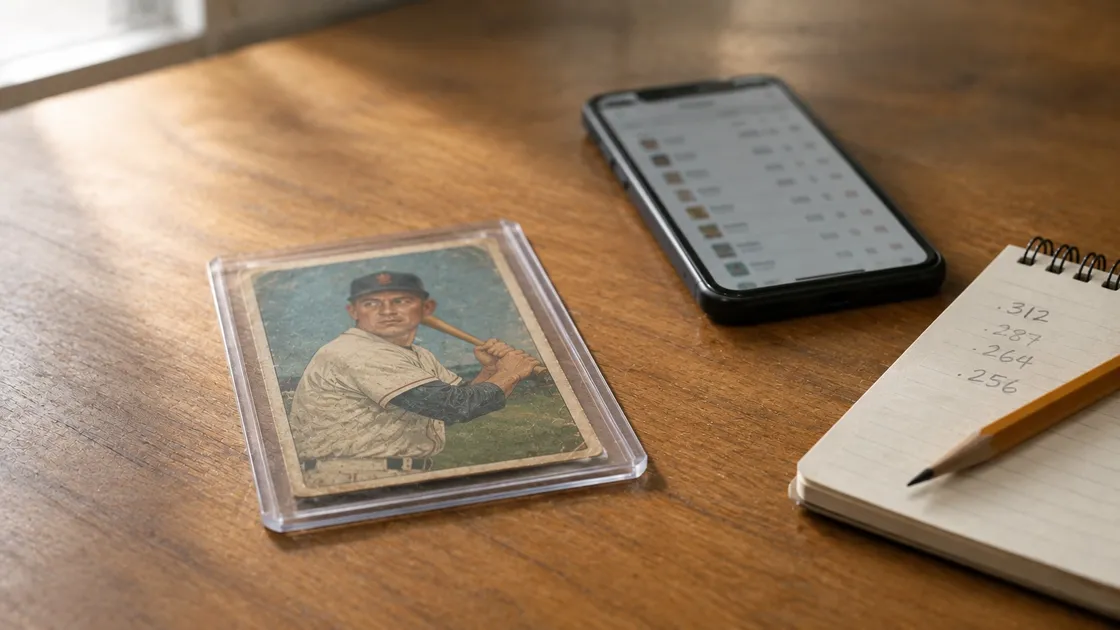
The single most common message I get is a screenshot. Someone has typed their card into a search bar, found a number with a lot of zeros in it, and wants to know if it’s real.
Usually it isn’t. Not because the card is fake, and not because anybody is lying, but because looking up a card’s value is one of those tasks that is easy to do badly and looks identical either way. The number comes back, it’s a real number on a real website, and there’s nothing on the screen to tell you it doesn’t apply to the card in your hand.
So here’s the method I’d use. It takes about four minutes per card and it will be closer than any guide.
| What you’re looking at | What it tells you |
|---|---|
| Asking price on an active listing | What one optimistic person wants. Nothing else |
| Sold price of a comparable copy | What somebody actually paid |
| Price guide value | A lagging estimate, usually of a nicer copy than yours |
| A graded copy’s sale | The value of a different product than your raw card |
Rule one: sold, not asking
This is most of the battle. On eBay you can filter to sold listings, and until you do that, everything you’re looking at is a wish.
There is no cost to listing a card at an absurd price and leaving it there for two years. Plenty of people do exactly that, sometimes because they genuinely believe it, sometimes because a high listing makes their other cards look like bargains. Those listings sit at the top of search results forever precisely because nobody buys them.
A completed sale is different. Two strangers with no reason to agree arrived at a number, and money moved. That’s the only kind of evidence worth anything here.
Rule two: match the card, exactly
Search the year, the set, the card number, and the player. All four. “1961 Topps 300 Mickey Mantle” rather than “Mickey Mantle card.”
Vintage sets are full of traps for anyone searching loosely. The same player appears in multiple sets in the same year, in league leader cards and All-Star cards and team cards, and those are all different cards with different values. Some issues have variations in back color or printing, where one version is ordinary and the other is scarce. If you’re not sure which one you have, that’s worth finding out before you compare anything.
If your card has no year printed on it, which most pre-1970s backs don’t, start by working out what year it is from. The copyright line on the back is the usual tell. Come back once you know.
Rule three: match the condition
This is where nearly every wildly wrong estimate comes from, and it’s the one people skip because it’s the one that requires judgement rather than typing.
On a vintage card, condition is most of the value. Not a modifier on the value: most of it. The same 1955 card can be a $40 card and a $4,000 card depending on centering, corners, edges and surface, and the photo in a sold listing was taken by someone whose job was to make their copy look good.
So before you compare, learn to read a card the way a buyer does, then go back through your sold results and delete every one where the copy is clearly nicer than yours. It is normal for that to remove most of them.
Rule four: a slab is a different product
A card sealed in a plastic holder with a number on it — PSA 7, SGC 4 — has been examined by a third party who staked their reputation on that assessment. A buyer bidding on it is buying certainty as much as cardboard.
Your raw card might be every bit as nice. It might be nicer. But nobody has certified that, so it sells into a different, more cautious market at a lower price. Comparing your raw card to a graded sale is the single most reliable way to arrive at a number two or three times too high. Whether it’s worth paying to have yours graded is a separate question with a real answer, and for most cards the answer is no.
Anyone can ask $2,000. The sold price is the only number that actually happened.
Read the middle, not the top
Once you’ve got a handful of genuinely comparable sales, resist the pull of the highest one.
The high sale is nearly always the best copy in the group, or an auction where two determined bidders got stuck on each other, or a card that sold at Christmas. The low one might be a damaged copy or a listing with terrible photos. The middle of the range is where your card most likely lives.
If you only found one comparable sale, you haven’t found a value — you’ve found an anecdote. Widen the search or accept that you don’t know yet.
What this method can’t do
It can’t price a shoebox. If you’ve inherited several boxes of mixed cards, do not attempt to look up two thousand cards one at a time. You’d be at it for months, and the answer at the end would be “most of these are worth a few cents each,” which is already true of anything printed from the mid-eighties on.
Look up the cards that could plausibly matter: the oldest ones, the names you recognize, and anything the previous owner stored differently from the rest. That last one is a good signal. People separate the cards they think are special, and they’re often right. Everything else is priced as a lot rather than card by card, which is a different exercise entirely.
It also can’t tell you what a buyer will pay. A sold price is retail, reached after fees, shipping and the seller’s time. Any offer for the whole collection sits below that, and it should: that gap is the buyer’s cost of doing business, not a trick.
The bottom line
Four minutes a card, on the ten or fifteen cards that could matter. Sold prices, matched card, matched condition, raw against raw, and read the middle.
Do that and you’ll walk into any conversation about your collection knowing roughly where you stand. That’s the entire point. You don’t need to become an expert. You need to know enough that nobody can tell you something untrue and have it work.
If you’d rather not do it at all, that’s what I’m here for. Send me photos and I’ll do this exercise on the cards that deserve it and tell you what I find, including the cards you should sell yourself because they’re worth more than I’d pay. You can also look at what vintage cards actually sell for by era to get your bearings first.
Key takeaways
- Asking prices are not values. Anyone can list a card for $2,000; the sold price is the only number that happened.
- Match the card exactly — year, set, card number — before you compare anything.
- Then match the condition. That is where nearly every bad estimate comes from.
- A graded copy in a slab is a different product from your raw card. Don't compare them.
- Read the median of the sold results, not the highest one. The high sale is usually the nicest copy, not yours.
Frequently asked questions
- What is the difference between a sold price and an asking price?
- An asking price is what one seller hopes to get, and it costs nothing to leave a wildly optimistic listing up for years. That's why those listings sit at the top of search results unsold. A sold price is a completed transaction between two strangers. Only the second one is evidence of anything.
- Why is the price I found so much higher than what I'm offered?
- Usually one of three reasons: the price you found was an asking price rather than a sale, the copy that sold was in much better condition than yours, or it was professionally graded and yours is raw. All three are common, and all three inflate the number.
- Do I need to look up every card in the collection?
- No, and you shouldn't try. In most collections a small handful of cards carry nearly all the value. Look up the oldest cards, the recognizable names, and anything that was stored separately from the rest. The bulk of the box is priced as bulk, not card by card.
- Are online price guides accurate for baseball cards?
- They are a starting point, not an answer. Published guides tend to lag the market and quote a card in a condition most surviving copies aren't in. Recent completed sales of comparable copies are closer to what your card would actually bring.