
How to Sell Baseball Cards Online Without Losing Money

This one is for people who’ve already decided to sell online. If you’re still weighing whether to do it yourself at all, that comparison lives here — different question, and for most collections the answer is “only for the good cards.”
So, assuming you’ve got cards worth listing. Here’s how to do it without handing back the difference in fees, postage, and avoidable mistakes.
| Platform | Real cost | Reaches | Best for |
|---|---|---|---|
| eBay | ~13%+ | Everyone | Most individual cards |
| Facebook groups | Low, plus payment fees | Collectors, unevenly | Known cards, repeat buyers |
| COMC | Per-card + commission | Serious hobby buyers | Volume mid-value cards |
| Mercari | ~10%+ | Casual buyers | Modern, lower-value |
eBay
Still the default, for one reason that outweighs the fees. It has the largest pool of buyers, and the completed-sales record establishes what things go for. When a card is scarce, the person willing to pay most for it is probably on eBay.
The real cost runs around 13% or more once the final value fee and payment processing are combined. Note that it applies to the whole transaction, including whatever the buyer paid for shipping. A $100 card nets you closer to $85, and you haven’t bought a mailer yet.
Two things separate a listing that works from one that doesn’t.
Photograph the flaws on purpose. Front, back, and a close shot of any corner ding, crease, or bad centering. Sellers instinctively shoot flattering photos, and that instinct is what generates “not as described” disputes three weeks later. A clearly visible flaw costs you a little on price and saves you the return.
Then title it the way somebody searches: year, set, player, card number, plain condition word. Not “RARE!! VINTAGE!!” Nobody has ever typed that into a search bar.
Facebook groups
Lower fees, direct access to collectors. Find a group that trades in your era and it can work well. The trade-off is a much smaller, less predictable audience and a lot less protection.
If you sell this way, use Goods & Services payment rather than Friends & Family, however much the buyer would prefer otherwise. Friends & Family strips their protection and your evidence. “Just send it F&F to save the fees” is the opening line of most Facebook card scams.
COMC and the consignment-style sites
COMC takes your cards in bulk, photographs and lists them, and holds them until they sell. You pay per card plus commission, and you skip shipping them one at a time. For somebody sitting on two hundred mid-value cards, that’s a real saving in hours.
You pay for it in patience and control. Cards can sit a long while, and you’re along for whatever the market does meanwhile. It suits volume, not a single great card. For one valuable card, a proper auction house is the better route.
The rule that saves the most money
Only list a card on its own if it’s worth roughly $20 or more.
Below that line the photographing, describing, listing, buyer questions, packing, and post office trip cost more in time than the card gives back. That’s before fees. Forty sell-worthy cards is 10 to 20 hours of work.
Everything under the line does better as lots. A complete year set, a team lot, a star player lot, “500 assorted 1970s commons.” Less per card, far more per hour.
Less per card, far more per hour. That's the trade that actually matters.
Shipping without disasters
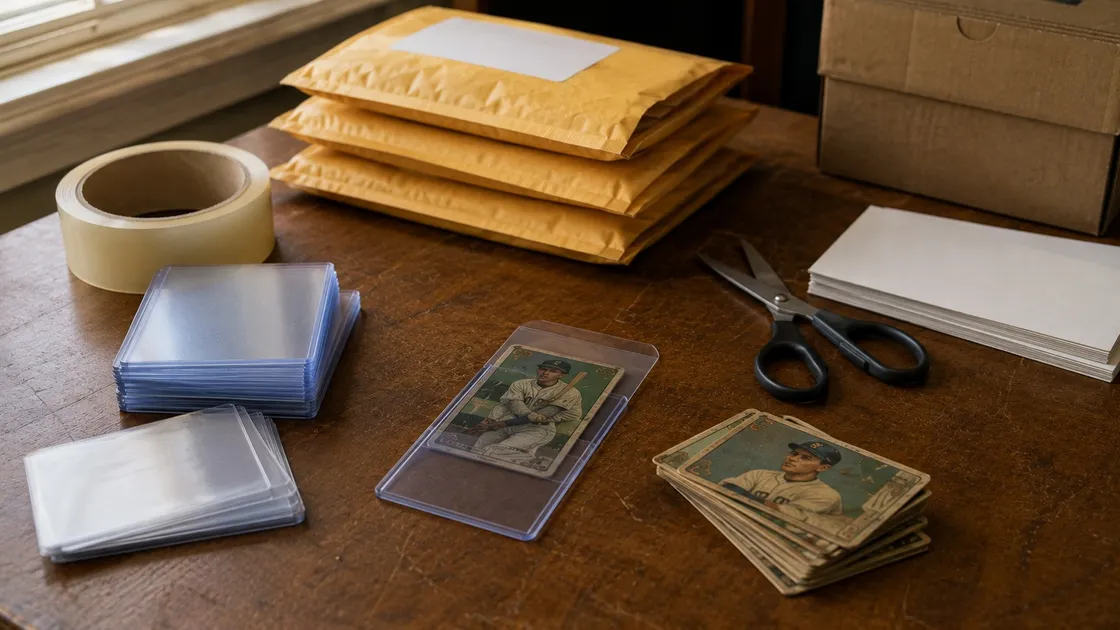
Cheap cards, under about $20: penny sleeve, top-loader, taped shut, plain white envelope with card stock either side. It’s cheap, and occasionally one vanishes, which is why it’s only for cheap cards.
Most cards: bubble mailer with tracking. Tracking is what wins a “never arrived” dispute. Without it you lose that dispute, every time.
Genuinely valuable cards: tracking, signature required, insured for the sale price.
And tape the top-loader shut. An untaped card works its way out in transit, and the corner damage that follows is precisely the damage that destroys the value you were shipping.
What isn’t worth selling online at all
Bulk. If you’ve inherited several boxes of mixed cards, the honest math is that listing them online, even as lots, takes months and returns very little. Most of those cards aren’t scarce, and no amount of good listing photography changes that.
The sensible split for most collections: sell the handful of good cards online where the fees are worth paying, and sell the rest as one lot to somebody local. You capture the upside where it exists and skip the tedium where it doesn’t.
If you want to know which of your cards fall on which side of that line, send me photos. I’ll tell you which ones are worth your time to list yourself, including when that means not selling them to me.
Key takeaways
- eBay's real cost is ~13%+ once the final value fee and processing are counted.
- The rough floor for listing a card on its own is about $20 — below that, your time costs more than the card returns.
- Ship anything worth over ~$20 with tracking; plain envelopes are for cheap cards only.
- Most disputes come from vague condition descriptions. Photograph flaws deliberately, not flatteringly.
- Never take payment off-platform. It's the single most common way sellers get robbed.
Frequently asked questions
- Where is the best place to sell baseball cards online?
- eBay for most individual cards, because it has by far the largest pool of buyers and a completed-sales record that establishes the price. Facebook groups can work for known collectors at lower fees, and COMC suits people with many mid-value cards who don't want to ship individually.
- How much does eBay take when you sell a card?
- Roughly 13% or more once the final value fee and payment processing are combined, applied to the total including what the buyer paid for shipping. Budget your shipping supplies on top of that.
- Is it worth listing baseball cards individually?
- Only above roughly $20 a card. Below that, the photographing, listing, packing, and postage take longer than the return justifies — those cards do better sold as sets, team lots, or year lots.
- How do I ship baseball cards safely?
- Penny sleeve, then a top-loader, taped shut, sandwiched in card stock inside a bubble mailer. Anything worth more than about $20 goes with tracking; genuinely valuable cards go signature-required and insured.