Are 1950s and 1960s Baseball Cards Worth Anything?

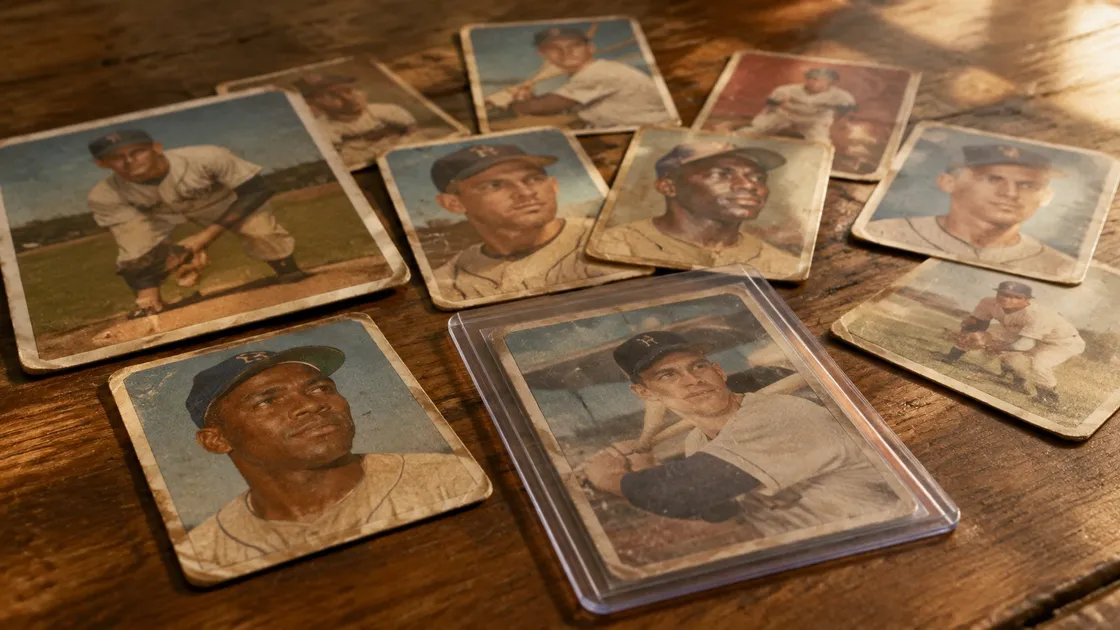
When people ask me whether their 1950s or 60s cards are worth anything, I usually get to give them good news.
1987 Topps are barely worth the paper they’re printed on. 1970s Topps commons go for about 10 to 20 cents apiece, even in nice condition. Cards from the 1950s and 60s are a different story. Almost every one of them has a buyer, and a fair share of them sell for serious money.
That’s also where people get into trouble. “Old cards are valuable” is close enough to true for this era that it’s easy to overshoot. Most of a 1950s or 60s box is commons, and commons don’t sell for much. The money sits in specific cards, and the job is finding them.
| 1950s | 1960s | |
|---|---|---|
| My sales behind these numbers | 268 | 238 |
| Commons | $3 to $15 sold singly, less by the box | Often under $1 each |
| Stars and key cards | $50 to $400 | $40 to $200 |
| Sold for over $100 | About 1 in 5 | About 1 in 10 |
| Who made them | Topps and Bowman | Almost all Topps |
What these cards actually sell for
I keep records of everything I sell. The ranges above come from about 500 of my own sales of 1950s and 60s cards since the start of 2025, the same numbers behind the card values page. They’re what raw, ungraded singles actually sold for, not asking prices. The one exception is the 1960s commons figure, which is what ordinary commons go for at retail.
Look at the commons. The 1950s figure of $3 to $15 is what a common sold for when it was clean enough, or wanted enough, for me to list it on its own. Most commons never get that chance. A box of them sells as a lot, and per card that works out to far less. In the 1960s, a common often brings under a dollar, less in rough shape.
The difference between the two decades is at the top. About one 1950s card in five sold for over $100, against about one in ten from the 1960s. For comparison, not one of my raw 1970s sales cleared $100.
Two cautions about the rest of the table. Those prices are what cards sold for over time, one at a time, not what anyone hands you for a box up front. And condition can move any single card by ten times in either direction, which no table can show you.
Why this era holds its value
These cards were bought by kids with pocket change. They got flipped, traded, rubber-banded, carried around in back pockets and thrown out with the rest of the childhood stuff. Far fewer survived than were printed, and far fewer survived in good shape.
Meanwhile, the people who grew up with them became the hobby’s biggest buyers. Add the set collectors, who need every card in a set including the players nobody remembers, and you get the reason even an ordinary card from this era has somewhere to go. I’ve written more about why old commons still sell while later ones mostly don’t.
Old commons sell. They just sell by the box, not at single-card prices.
The 1950s: two makers and the high numbers
For the first half of the decade, Topps and Bowman competed head to head. Bowman’s last set was 1955, and Topps had the field almost to itself after that. If you’re holding a Bowman card from that era, it’s from 1955 or earlier.
Size helps too. Topps cards from 1952 through 1956 are noticeably bigger than a modern card, and 1957 is the year Topps settled on the size cards still are today. A card that’s larger than the ones you’re used to is a good sign you’re in the early fifties. If the year isn’t obvious, the back usually tells you.
Then there are the high numbers. Topps released its sets in series through the spring and summer, and the last series came out late in the season, when fewer packs were selling. Fewer were printed, and fewer survive. The famous example is 1952 Topps, where the last series starts at card 311, and card 311 is Mickey Mantle. On a lesser scale the same rule holds across the decade: the highest card numbers in a set are usually the scarcer ones.
The rookies worth checking for:
- Willie Mays and Mickey Mantle, 1951 Bowman. Plenty of people think the 1952 Topps is Mantle’s rookie card. It’s his first Topps card, which is valuable in its own right, but his rookie card is the Bowman.
- Hank Aaron and Ernie Banks, 1954 Topps.
- Roberto Clemente and Sandy Koufax, 1955 Topps.
And any star in clean condition: Mantle above everyone, then names like Jackie Robinson, Ted Williams and Satchel Paige.
The 1960s: one maker, bigger sets, the same rule
By the sixties it was almost entirely Topps, and the sets got big, often more than 500 cards a year. That’s a lot of common players, and it’s why a box of 1960s commons is worth less per card than most people expect.
The high-number rule still applies. Topps kept releasing in series right through the decade, so the last series of each year is still the scarce part of the set, and those cards carry a premium even for players nobody has heard of.
The rookies:
- Carl Yastrzemski, 1960 Topps.
- Pete Rose, 1963 Topps. Shared with three other rookies on one card, so it’s easy to miss.
- Nolan Ryan, 1968 Topps. Shared with Jerry Koosman.
- Reggie Jackson, 1969 Topps.
Mantle is still the card to look for in any 1960s box, all the way to his last card in 1969. After him come Aaron, Mays, Koufax and Bob Gibson.
Condition decides where in the range a card lands
A 1955 star card can sell near the bottom of that $50 to $400 range or near the top, and the difference is almost entirely condition: centering, corners, edges and creases. Here’s how a buyer reads those.
Go easy on yourself when you look, though. Cards this old are supposed to show wear. A card that comes back a 5 on the grading scale is a normal 1950s card, not a disappointment, and it sells fine. What moves the price is when a card is noticeably nicer than most surviving copies, or noticeably worse.
The famous ones are also the most reprinted
The 1952 Topps Mantle and the big rookies of this era are among the most reprinted cards in the hobby. Most reprints were made honestly as collectibles, and most say so on the back in small print. Decades later they turn up in a shoebox looking like the real thing.
The tells are usually the card stock, which is too thin, too white or too glossy, and a back that’s cleaner than seventy years should allow. The fakes and altered cards post goes into what I actually look at.
Where these fit in what I buy
These two decades are the center of what I buy. That includes the stars and rookies, but also the complete and partial sets, team lots and loose commons. I want the ordinary cards too, because in this era they’re worth something.
If one card in your box would do better at auction than with me, I’ll say so, and tell you how consignment works for a card like that.
The bottom line
1950s and 60s cards are worth something, almost all of them. Most of a box is commons, and those are worth something as a box, not a few dollars apiece. The money concentrates in Mantle, the other Hall of Famers, the key rookies, the late-season high numbers and any card whose condition stands out from the rest. Those are the ones to set aside and look at closely.
If you’d rather not sort through it yourself, take a few photos, fronts of the best cards and backs of a few, and send them to me. I’ll tell you which cards in the box are the ones worth caring about, and what they’re worth. You can also see what each era actually sells for before you talk to anyone.
Key takeaways
- Almost every card from these two decades has a buyer, but commons sell cheap. A 1960s common can be worth less than a dollar, especially in rough shape.
- Stars and key cards are where the money is: roughly $50 to $400 raw for the 1950s and $40 to $200 for the 1960s in my sales.
- The late-season high numbers were printed in smaller runs and are scarcer today, in both decades.
- Condition decides which end of the range a card lands on. A vintage card with honest wear is normal, not a failure.
- The famous cards from this era are also the most reprinted. Check the back before you get excited.
Frequently asked questions
- Are all 1950s baseball cards valuable?
- Nearly all of them are worth something, but most aren't worth much. Commons usually sell as a lot, for much less per card than a single listing would suggest. The value concentrates in Hall of Famers, rookie cards, the scarcer high-number series and cards in unusually good condition. Those are the cards worth pulling out and looking at closely.
- Which 1960s baseball cards are worth the most?
- Mickey Mantle is the card to look for in any 1960s Topps box. After him come the other stars of the decade, such as Hank Aaron, Willie Mays, Sandy Koufax and Bob Gibson, and the key rookie cards: Carl Yastrzemski in 1960, Pete Rose in 1963, Nolan Ryan in 1968 and Reggie Jackson in 1969. Condition decides how much any of them brings.
- Are 1950s cards worth more than 1960s cards?
- At the top end, usually. Commons from either decade sell cheap, often as a lot. The difference is in the stars and key cards, where the 1950s run higher. Of the cards I've sold one at a time, about one 1950s card in five went for over $100, compared with about one in ten from the 1960s.
- How can I tell if a 1950s baseball card is a reprint?
- Start with the back. Reprints usually say so in small print, often with a later copyright year. The card stock is another tell: originals are thick, slightly rough cardboard, while many reprints are thinner, whiter or glossier. A famous card that looks too clean for its age deserves a second opinion before you count on it.