Are 1980s and 1990s Baseball Cards Worth Anything?

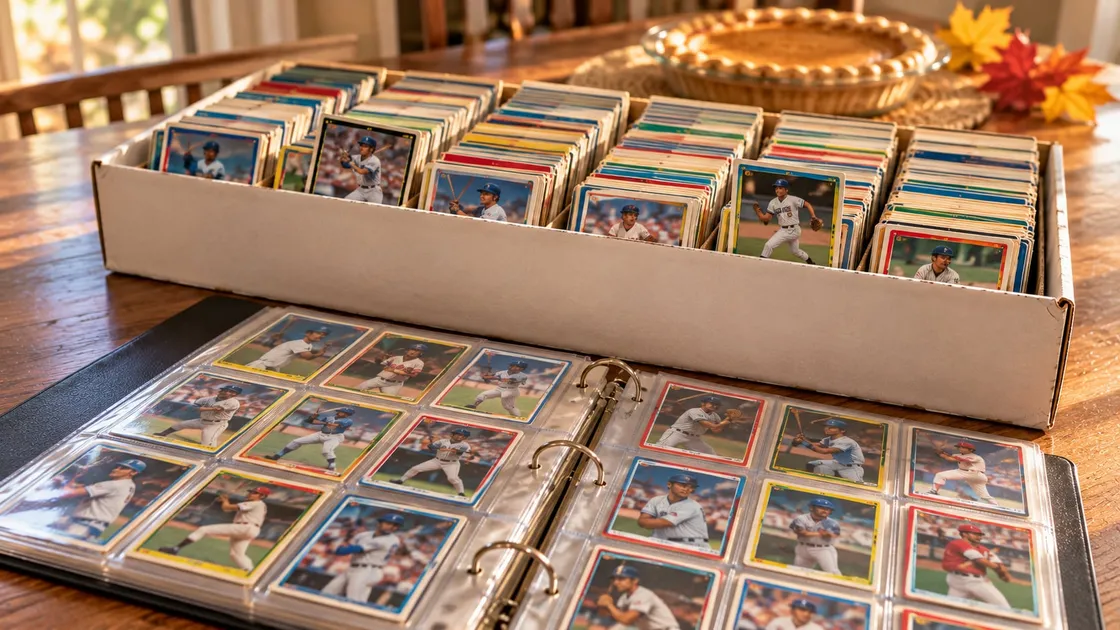
Thanksgiving week is when the boxes come out. A spare bedroom gets cleared for guests, a closet gets opened, and there it is: a 5-row box of cards, or a binder of plastic pages from 1989. Somebody holds one up at the table and asks the question. Are these worth anything?
If the cards are from the 1980s and 90s, here’s the honest answer. Most of them, no. Ordinary cards from those years sell for pennies, if they sell at all, and that’s true even when they look brand new.
But most isn’t all. A few cards from those two decades sell for real money, and they’re easy to miss in a box of five thousand. Here’s which ones to look for before anybody tosses the box or gives it away.
| Early 1980s (1980 to 1986) | Junk wax (about 1987 to 1994) | Later 1990s (about 1995 to 1999) | |
|---|---|---|---|
| Ordinary cards | Mostly low, stars do better | Pennies, if they sell at all | Pennies |
| Where the money is | Star rookies, top grades, scarce versions | Key rookies in top grades, a few famous errors | Inserts, parallels, serial-numbered cards |
| What to pull out | Cal Ripken Jr. (1982 Traded), Rickey Henderson, Don Mattingly | Ken Griffey Jr., Barry Bonds, Frank Thomas, Derek Jeter | Anything shiny, numbered or marked as an insert |
Why most cards from these years are worth so little
By the late 1980s, everyone knew old baseball cards could be worth money. Card companies printed accordingly, collectors bought by the case, and they saved their cards in perfect condition because they expected them to be worth something someday. Then the hobby’s buying crowd shrank after its peak in the early 90s, according to The Cardboard Connection, and the cards stayed.
That’s why a mint 1988 card can sell for less than a beat-up 1958 one. A card needs to be scarce and wanted. These cards still have collectors, but they’re everywhere. Plenty of us who opened these packs as kids already have a closet full of our own. I’ve written the long version of this in the 1987 Topps post, and the commons post covers why old commons still sell while these mostly don’t.
A box of 1980s and 90s cards is usually worth a few good cards, not a few thousand ordinary ones.
The early 1980s: better than what came after
Fleer and Donruss joined Topps in 1981, and the early part of the decade came before the printing boom. Even so, only a few cards from these years bring real money without a top grade. Here’s roughly what the best-known rookies sell for ungraded, from SportsCardsPro’s sold-price guide as of November 8, 2026:
- Cal Ripken Jr., 1982 Topps Traded: about $175.
- Rickey Henderson, 1980 Topps: about $70. Raw copies sold for $45 to $61 on November 7 and 8.
- Don Mattingly, 1984 Donruss: about $70.
- Tony Gwynn, Wade Boggs and Ryne Sandberg, 1983 Topps: about $12 to $18 each.
- Mark McGwire, 1985 Topps, pictured with the U.S. Olympic team: about $12.
- Nolan Ryan, 1980 Topps: about $7. His rookie card is from 1968, so his 80s cards are later cards of a star, and there are a lot of them.
Here’s the catch. The big prices you see quoted for these cards are for near-perfect grades. That same Henderson rookie is about $3,800 in a grade 9 and about $162,000 in a PSA 10, per SportsCardsPro, and a PSA 10 only sells about twice a year. Ryan’s 1980 card, about $7 raw, is close to $900 in a 9. A card that spent 40 years in a box is very unlikely to grade that high.
Two less obvious things to watch for, in the early 80s and after:
- Cards with French on the back. Those are O-Pee-Chee, the Canadian version of Topps, printed in much smaller numbers. Some of the most valuable cards of the decade are O-Pee-Chee rookies.
- Cards that are shinier than the rest. From 1984 to 1991, Topps also sold glossy “Tiffany” sets on white card stock, in runs of roughly 5,000 to 30,000 sets, per The Cardboard Connection. Regular Topps from those years were printed by the millions.
The junk wax years: three things to check
From about 1987 to 1994, almost everything is common. There are still three things worth looking for.
Key rookie cards. The 1989 Upper Deck Ken Griffey Jr. is the famous one, and it has gone up. As of November 8, 2026, SportsCardsPro puts an ungraded copy at about $100, with raw eBay sales from November 6 to 8 mostly between $80 and $125. A PSA 9 is about $415 and a PSA 10 about $5,300. Most other rookies from these years sell for a few dollars raw. A regular 1990 Topps Frank Thomas goes for $2 to $3, and a 1987 Topps Barry Bonds for about $3. The 1993 SP Derek Jeter is the other exception, at about $130 raw.
For the bigger picture, my card values page shows what cards from each era actually sell for, from pre-war through the junk wax years.
A few famous error cards. Not the ink smudge or crooked cut you spotted. Those were repeated across tens of thousands of cards, and I’ve written about why they’re almost never worth anything. A handful of documented errors are different:
-
1990 Topps Frank Thomas, no name on front. The regular Thomas rookie is about $150 even in a perfect PSA 10. The rare version missing his name at the bottom is a different story. An SGC 6 copy sold for $12,000 on eBay in April 2026, and SportsCardsPro puts a grade 8 around $20,000. Here’s my Instagram reel on this card:
Watch my Instagram reel on the Frank Thomas no-name card
-
1989 Fleer Billy Ripken, #616. The original shows a four-letter word written on the knob of his bat. Fleer covered it up several different ways. Ungraded, the original error sells for about $75 and the black box version for about $5, per SportsCardsPro as of November 8, 2026.
-
1989 Fleer Randy Johnson, #381. A Marlboro ad is visible on the scoreboard behind him. Later printings blacked it out. In a PSA 10, the version with the ad showing is about $1,475 and the fully blacked-out one about $64, per the same guide. Raw, the blacked-out card sells for a dollar or two.
The right card in a perfect grade. The 1993 SP Derek Jeter rookie shows how far the top end goes. SportsCardsPro puts a PSA 10 around $254,000 and a grade 9 around $5,700, while a raw copy is about $130. Most copies are nowhere near a 10, and that gap is where the money is in this era.
The later 1990s: the money moved to the inserts
Card companies responded to the glut by making some cards scarce on purpose. Packs started carrying inserts (special cards seeded at random), parallels (versions of base cards with a different finish), and cards stamped with a serial number. The first serial-numbered cards were 1991 Donruss Elite, limited to 10,000 each, per The Cardboard Connection. Later sets went much lower.
Those are the cards that carry money from this period. A 1993 Finest Refractor Barry Bonds has sold raw for $1,000 to $1,900 in 2026, per SportsCardsPro, while the base cards from those same years still sell for pennies.
What to set aside from a late-90s box: anything with a number like 0042/1000 printed on it, anything with a rainbow shine the cards around it don’t have, and anything that says “insert” or names a special subset on the back.
Basketball: it’s mostly about Jordan
The same rules hold for basketball cards from these years, with one name that changes the math. The 1986 Fleer Michael Jordan rookie, #57, sells for about $4,250 ungraded and around $14,400 in a grade 8, per SportsCardsPro as of November 8, 2026. It’s also one of the most faked and altered cards in the hobby, so have one checked before you count on it. Here are the warning signs I look for.
Late-90s basketball follows the late-90s baseball pattern: the right rookies and the shiny versions carry the money. A 1996 Topps Kobe Bryant rookie sells for about $100 raw. The Topps Chrome version of the same card is about $1,600.
Don’t let the junk wax hide the older cards
Boxes like this rarely stay in one decade. A box with 1989 Donruss on top can have 1970s Topps underneath, or a stack of 1960s cards somebody’s dad passed down. Those older cards follow very different rules. Almost every 1950s and 1960s card has a buyer, and 1970s cards are still genuine vintage. If you’re not sure what year a card is, the back usually tells you. And if the box is your own, from when you were a kid, here’s what I’d think about first.
Should you get them graded?
For almost all of them, no. Grading typically costs $15 to $75 or more per card, and an ordinary card from these years is worth less than the fee. The cards worth considering are the key rookies and documented errors that look sharp enough to come back a 9 or 10, since that’s where nearly all the value in this era sits. The grading post walks through when it pays, and this one explains what the grades mean.
The bottom line
Most 1980s and 90s cards are worth more as a memory than as money. The ones that break the pattern are a handful of star rookies, a few documented errors, the scarce versions like O-Pee-Chee and Tiffany, the inserts and numbered cards of the later 90s, and in basketball, Jordan’s 1986 Fleer rookie. In this era, the value comes from the right card in the right condition, not from how many cards you have.
If the box came out this Thanksgiving, take a few photos of the cards that stand out, plus a stack or two of the rest, and send them to me. I’m actively looking for mid- to late-90s collections, mostly baseball but basketball too, and I’ll take the 80s and early-90s cards that come with them. If a box is all 80s and 90s baseball, I’ll usually pass on buying it, but I’ll still tell you what you have, whether anything in there breaks the pattern, and where it’s best sold. Sometimes the honest answer is “keep these for the memories.” You’ll get that one too.
Key takeaways
- The 1980s and 90s are really three different markets: the early 80s, the junk wax years (about 1987 to 1994), and the insert era of the later 90s.
- Ordinary cards from the junk wax years sell for pennies, if they sell at all, even in perfect condition.
- Most rookie cards from these years sell for a few dollars to under $20 raw. The 1982 Topps Traded Ripken, 1989 Upper Deck Griffey and 1993 SP Jeter are among the few that bring $100 or more ungraded, and the big money is in near-perfect grades.
- A handful of documented error cards carry real money. Most "errors" people find don't.
- From the mid-90s on, the scarce cards are the inserts, parallels and serial-numbered cards, not the base set.
- In basketball, the 1986 Fleer Michael Jordan rookie sells for thousands even ungraded.
Frequently asked questions
- Are 1980s baseball cards worth anything?
- Most aren't worth much, but the early 80s hold up better than the late 80s. The 1982 Topps Traded Cal Ripken Jr., 1980 Topps Rickey Henderson and 1984 Donruss Don Mattingly rookies sell for about $70 to $175 ungraded. Many other Hall of Famers' cards, like Tony Gwynn's and Nolan Ryan's, sell for under $20 raw. The big prices are for cards in near-perfect grades.
- Are 1990s baseball cards worth anything?
- Base cards from the 1990s usually sell for pennies. The exceptions are a few rookies like the 1989 Upper Deck Ken Griffey Jr. and 1993 SP Derek Jeter, a few documented error cards, and the inserts, parallels and serial-numbered cards of the later 90s.
- What is the junk wax era?
- The hobby's name for roughly 1987 to 1994, when card companies printed cards by the billion and collectors saved them in mint condition. That oversupply is why most cards from those years are worth very little.
- How much is a 1989 Upper Deck Ken Griffey Jr. rookie worth?
- It depends almost entirely on condition. As of November 2026, an ungraded copy sells for about $80 to $125, a PSA 9 for about $415 and a PSA 10 for about $5,300, per SportsCardsPro.
- Is a 1986 Fleer Michael Jordan rookie worth anything?
- Yes. It's the most valuable card of the era, at about $4,250 ungraded as of November 2026, per SportsCardsPro. It's also heavily counterfeited, so have it checked before you count on that number.
- Should I get my 1980s and 90s cards graded?
- Usually not. Grading costs $15 to $75 or more per card, more than most of these cards are worth. Consider it only for key rookies and documented errors in sharp enough condition to grade a 9 or 10.
- Should I throw away my old baseball cards?
- Not before someone checks them. The valuable rookie, error or insert is easy to miss, and older cards are often mixed in underneath.